

Podcast Recommendation
For an in depth discussion about the benefits of fish and omega-3 essential acids, listen to #068 Dr. Bill Harris on the omega-3 index on Found my Fitness with Dr Rhonda Patrick
What is so special about fish?
Oily fish contain essential fatty acids (EFAs). Specifically it is the best source of Omega-3 essential fatty acids. It is called essential because our bodies cannot synthesise it from other substrates. We need to consume EFAs in our diet.
As an example, our cells can make cholesterol from the precursor molecule acetoacetyl-CoA, and cholesterol in turn is used to make hormones like oestrogen and testosterone. We can also get cholesterol from our diet.
Essential fatty acid classification and naming can be a bit confusing.
The broad classification, polyunsaturated omega-6 and omega-3 is well known. They are also called Linoleic Acid (LA) and Alpha-Linolenic Acid (ALA) respectively.
Linoleic acid from plant foods is converted by enzymes into Arachidonic Acid (AA) and Αlpha-Linolenic Acid is converted into Eicosapentaenoic Acid (EPA) and Docosahexaenoic Acid (DHA). Animal foods contain Arachidonic acid, EPA and DHA. (For simplicity, the docosapentaenoic fatty acid, DPA, is ignored here).
If you are already lost, the figure below should help to put this into perspective.
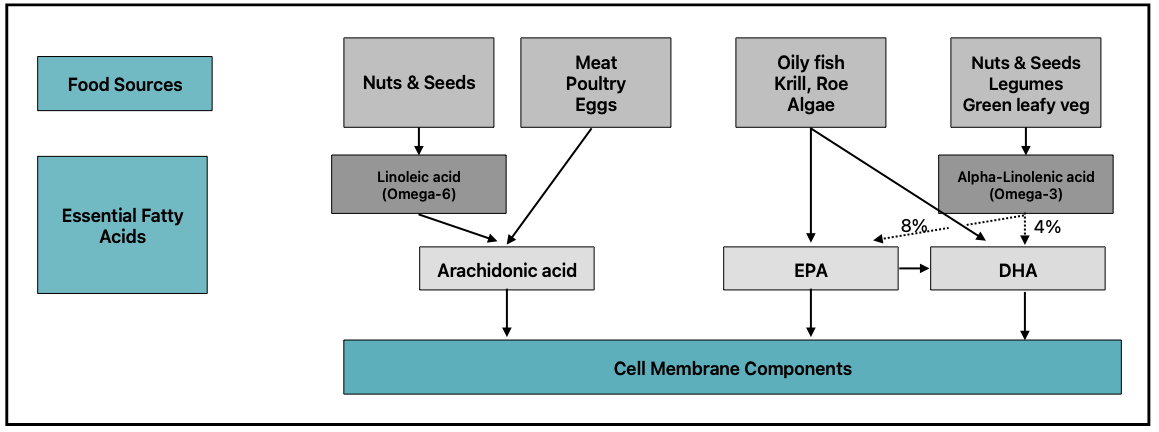
Fortunately for this discussion, you only have to remember that omega-3s convert into EPA and DHA and that marine foods are our best food sources. Nuts, seeds, legumes and leafy greens contain some omega-3 as ALA. Flax oil is the best plant source of ALA.
Unfortunately our bodies are not very good at converting ALA into EPA and DHA. About 8% of ALA is converted into EPA and 4% into DHA1.
Omega’s from food
Broadly, ALA is obtained from plants and EPA and DHA from animal food sources, mainly oily fish. The best food sources of EPA and DHA include sardines, mackerel, salmon, herring, anchovies and oysters.
Plant food sources of ALA include flax seeds and oil, chia seeds, walnuts.
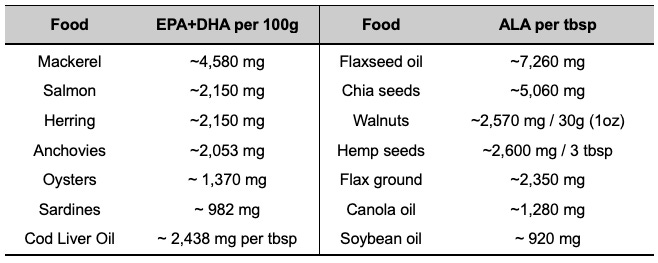
The USA nutrient guidelines recommend 1.6g and 1.1g of ALA intake per day for men and women respectively. Australian guidelines are a bit lower with 1.3g and 0.8g per day for men and women respectively.
Eating only 100g of oily fish per day will provide more than the minimum requirement for health.
Nutritional recommendations are to consume 200g oily fish 2-3 times per week.
At a conversion rate of 8%, a tablespoon of flaxseed oil provides 581mg of EPA and 290mg of DHA - a total of 871 mg omega-3 potential. This is a simplified assumption and does not take into account genetics and other factors.
Where are EFAs stored and used?
EFAs are integral for many physiological processes, including2:
Essential structural component of all cell membranes
Brain and nervous system structure and function
Skin health and function
Heart health
Mental health
Inflammation regulation - initiating and resolving
Unlike other fats, EPA/DHA are not stored in sufficient quantities in your fat cells. EPA/DHA are primarily stored in cell phospholipid membranes where it influences the membrane fluidity and permeability. The highest concentration of DHA is found in brain, nerve and retinal cells. Heart and immune cells contain high quantities of both EPA and DHA.
In the presence of certain chemical alarm signals called cytokines, they are released from membranes by enzymes called phospholipases, to initiate the pro-inflammatory and pro-resolving cascade of inflammation. More on this next time.
Do you have enough EPA/DHA?
The level of EPA/DHA can measured in red blood cells and this serves as a biomarker for tissue omega-3 status. You can order an Omega-3 Index test through testing laboratories including I-screen and Nutripath in Australia and Mosaicdx, OmegaQuant and others in the USA.
An index of >8% is the optimal level reflecting the proportion of long-chain omega-3s, EPA and DHA, of all the fatty acids in the red blood cell membranes.

As most cells in the body are constantly being replaced by new cells, we need ongoing EPA/DHA supply. This demand increases with injury, disease and inflammatory states.
General supplementation guidelines are for 1-3g of combined EPA/DHA per day.
You can supplement with fish oil or EPA/DHA in liquid or gel capsules. The quality of EPA/DHA supplements is very important, because the oils can be degraded easily. As a clinical nutritionist I would not recommend getting your fish oil from the supermarket.
Brief overview of EPA/DHA in Health and Disease Role
Heart health
The REDUCE-IT trial3 is perhaps the best known study for evaluating the effect of EPA supplementation on reducing triglycerides. The key finding was a 25% reduction in major cardiovascular events in those patients receiving 4g/day pure EPA compared to placebo. This specific EPA product is prescription only.
The 20214 and 20235 meta-analyses confirmed the benefit of supplemental EPA/DHA for heart health with EPA performing better in this clinical situation.
Brain health
Supplementing with EPA/DHA improves learning, memory, cognitive well-being and brain blood flow6.
Omega-3s are neuroprotective with dementia risk shown to be reduced by 20%7.
It has also been shown to effective in reducing symptoms of Alzheimers8.
Depression and Anxiety
EPA seems to give superior results over DHA in depression and anxiety studies. In combined supplementation, the EPA proportion should be more that 60% of total omega-39.
The latest study by Bafkar at al. (2024) indicates greater efficacy in reducing anxiety with >2g/d omega-3 and better results when combined with anti-depressants10.
Inflammation
Supplementation dramatically improves inflammatory markers and resolution of inflammation1112.
Cancer
In conjunction with chemotherapy and or radiotherapy, omega-3 supplementation improves outcomes by reducing negative side-effects13. In cell culture studies (not in human trials) DHA also has direct cytotoxic effects and inhibit cell growth. In chronic leukemia and lymphoma cancer patients, EPA and DHA supplementation improved overall health and reduced cancer-induced cachexia (weight loss)14.
Overall, many studies indicate that supplementation with EPA/DHA benefits cancer patients by decreasing side-effects, reducing cachexia, improving overall health and possibly have direct anti-tumour effects.
Final Words
For me, EPA/DHA supplementation is a daily essential and I recommend it to all my patients.
About Estelle
Estelle began her career in financial modelling and reporting in the mining industry. Making a left turn in careers, she obtained her Bachelor of Biomedical Science in 2017 and a Bachelor of Health Science Nutrition & Dietetic Medicine in 2020. She is also a qualified breath coach. These formal qualifications inform her philosophy about health, nutrition, and breathing, shaping her clinical focus. Estelle sees patients for a variety of complex problems including insomnia, fatigue and chronic illnesses.
References:
Burdge, Graham C et al. “Eicosapentaenoic and docosapentaenoic acids are the principal products of alpha-linolenic acid metabolism in young men*.” The British journal of nutrition vol. 88,4 (2002): 355-63. doi:10.1079/BJN2002662
Glick NR, Fischer MH. The Role of Essential Fatty Acids in Human Health. Journal of Evidence-Based Complementary & Alternative Medicine. 2013;18(4):268-289. doi:10.1177/2156587213488788
Bhatt, Deepak L et al. “Rationale and design of REDUCE-IT: Reduction of Cardiovascular Events with Icosapent Ethyl-Intervention Trial.” Clinical cardiology vol. 40,3 (2017): 138-148. doi:10.1002/clc.22692
Khan, Safi U et al. “Effect of omega-3 fatty acids on cardiovascular outcomes: A systematic review and meta-analysis.” EClinicalMedicine vol. 38 100997. 8 Jul. 2021, doi:10.1016/j.eclinm.2021.100997
Samuel C R Sherratt, R Preston Mason, Peter Libby, Ph Gabriel Steg, Deepak L Bhatt, Do patients benefit from omega-3 fatty acids?, Cardiovascular Research, Volume 119, Issue 18, December 2023, Pages 2884–2901, https://doi.org/10.1093/cvr/cvad188
Dighriri, Ibrahim M et al. “Effects of Omega-3 Polyunsaturated Fatty Acids on Brain Functions: A Systematic Review.” Cureus vol. 14,10 e30091. 9 Oct. 2022, doi:10.7759/cureus.30091
Wei, Bao-Zhen et al. “The Relationship of Omega-3 Fatty Acids with Dementia and Cognitive Decline: Evidence from Prospective Cohort Studies of Supplementation, Dietary Intake, and Blood Markers.” The American journal of clinical nutrition vol. 117,6 (2023): 1096-1109. doi:10.1016/j.ajcnut.2023.04.001
Castellanos-Perilla, Nicolás et al. “An analysis of omega-3 clinical trials and a call for personalized supplementation for dementia prevention.” Expert review of neurotherapeutics vol. 24,3 (2024): 313-324. doi:10.1080/14737175.2024.2313547
Sublette, M Elizabeth et al. “Meta-analysis of the effects of eicosapentaenoic acid (EPA) in clinical trials in depression.” The Journal of clinical psychiatry vol. 72,12 (2011): 1577-84. doi:10.4088/JCP.10m06634
Bafkar, Negar et al. “Efficacy and safety of omega-3 fatty acids supplementation for anxiety symptoms: a systematic review and dose-response meta-analysis of randomized controlled trials.” BMC psychiatry vol. 24,1 455. 18 Jun. 2024, doi:10.1186/s12888-024-05881-2
Banaszak, Michalina et al. “Role of Omega-3 fatty acids eicosapentaenoic (EPA) and docosahexaenoic (DHA) as modulatory and anti-inflammatory agents in noncommunicable diet-related diseases - Reports from the last 10 years.” Clinical nutrition ESPEN vol. 63 (2024): 240-258. doi:10.1016/j.clnesp.2024.06.053
Kelaiditis, Christos F et al. “Effects of long-chain omega-3 polyunsaturated fatty acids on reducing anxiety and/or depression in adults; A systematic review and meta-analysis of randomised controlled trials.” Prostaglandins, leukotrienes, and essential fatty acids vol. 192 (2023): 102572. doi:10.1016/j.plefa.2023.102572
de Aguiar Pastore Silva, Juliana et al. “Omega-3 supplements for patients in chemotherapy and/or radiotherapy: A systematic review.” Clinical nutrition (Edinburgh, Scotland) vol. 34,3 (2015): 359-66. doi:10.1016/j.clnu.2014.11.005
Moloudizargari, Milad, et al. “Effects of the polyunsaturated fatty acids, EPA and DHA, on hematological malignancies: a systematic review.” Oncotarget [Online], 9.14 (2018): 11858-11875. Web. 6 Oct. 2025