

In my role as Clinical Nutritionist, I get the asked frequently if adding collagen powder is a good thing. And yes, it can be. But what is cannot do is count towards your daily protein intake.
The protein in foods is used by the body as the building blocks for structures including new cells, immune cells, hormones, enzymes, neurotransmitters, bones, and muscles.
What are Proteins?
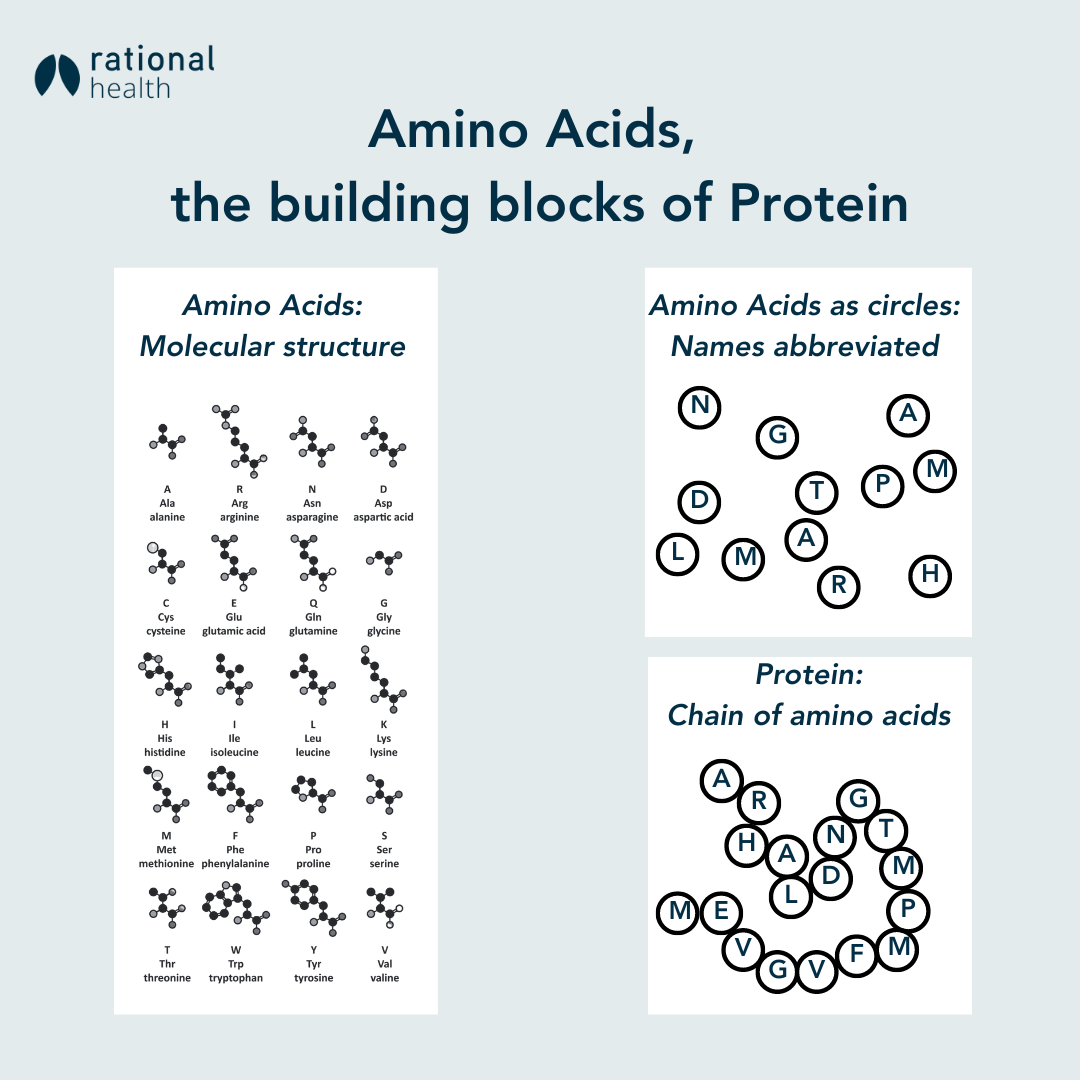
Proteins are made up of strings of molecules called amino acids - just like carbohydrates are different forms of sugar and starches. There are about 20 common amino acids needed to make all the proteins found in the human body. Nine (9) of these are Essential Amino Acids (EAA) - this means that we HAVE to get them from foods that we eat [1] [2]. The other 11, our bodies can make through chemical reactions and are called non-essential. Our bodies are constantly degrading and remaking protein structures and some are lost in the process through dead skin, hair or nail cells, sweat, urine and faeces.
Amino acids are the building blocks of protein
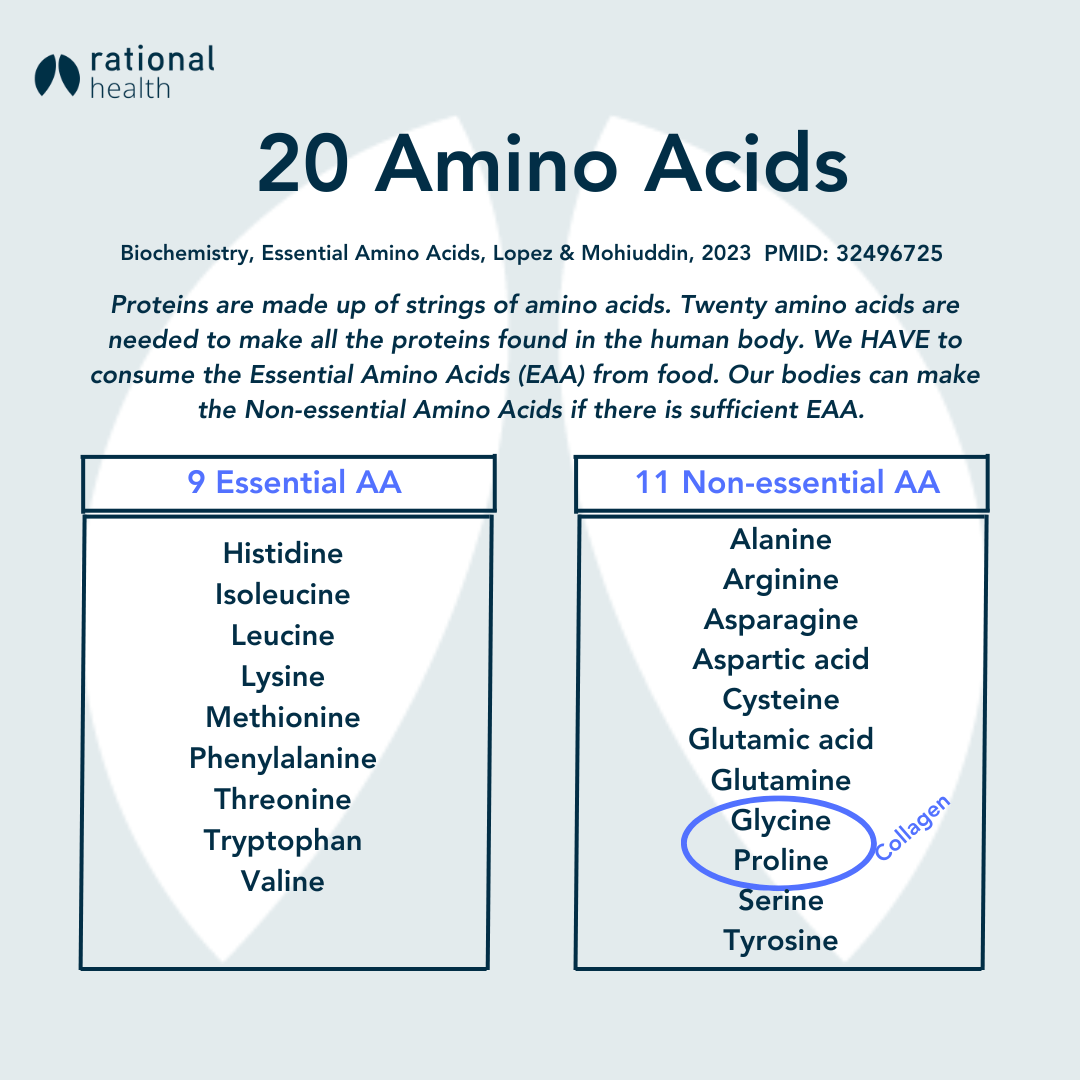
The essential amino acids are histidine, isoleucine, leucine, lysine, methionine, phenylalanine, threonine, tryptophan and valine. We also need them in a certain minimum ratio - we need more leucine than tryptophan for instance. Food that contains these 9 amino acids are called "complete protein foods". All animal foods are complete proteins, while most plant foods are "incomplete" meaning that it lacks one or more of the 9 essential amino acids or does not have the optimal ratio [3]. Only soy is considered a complete protein is considered. Lentils are too low in methionine for example and rice is low in lysine [4][5].
Nine amino acids are essential (EAA) and have to be obtained from food, our bodies cannot make them
Collagen structure
Collagen is made from chains of mainly three amino acids: glycine, proline and hydroxyproline [6] [7]. Every third amino acid is glycine. Most of the other 17 amino acids can be incorporated in the collagen fibre - but it is in very low quantities. Importantly it lacks the amino acid tryptophan, so this means that collagen is not considered a complete protein food for maintaining adequate nutrition. You should not count is as part of your protein target.
The three main amino acids in collagen are glycine, proline and hydroxyproline
The argument could be made that if you consume the optimum protein intake of 1.2-1.8g/kg ideal body weight [8] [9] [10], mostly from complete protein sources that you will have enough essential amino acids to allow your body to make collagen.
Research
The work of Keith Baar show in vitro that gelatine supplementation can augment collagen synthesis [11] [12]. In a small, randomised trial, his work show that the blood circulation of pro-collagen amino acids was increased 1 h after ingestion and concludes that “supplementation may improve collagen synthesis when taken 1 hour prior to exercise” [13].
It is important to keep in mind that tendons and ligaments in general have low blood flow and only have higher blood flow during exercise [14]. The best strategy to enhance the probability that supplementation of collagen powder will reach the target area is to exercise 60 minutes after ingestion. Most of the research related to collagen and injury repair, supplement with 15g gelatine, 60 minutes before exercise.
When it comes to rehabilitation from injury, it is important to note the synthesis of new collagen is an adaptive response to mechanical loading [14]. In other words, it is the resistance exercise that stimulate the signal to make new collagen. Optimising the availability of key nutrients (proline and vitamin C) together with appropriate exercise can give better results in terms of connective tissue repair.
Resistance exercise increase tendons and ligament synthesis.
Other researchers in protein metabolism, including Stuart Phillips have pointed out mechanical stimulation is sufficient to increase collagen synthesis in the presence of adequate protein availability [15] [16] [17].
Last words
In certain situations, you might need the additional substrates to repair collagen structures when you have an injury for instance or have a chronic disease like scleroderma. This is especially true if you do not consume animal proteins regularly or of your animal protein foods are low in collagen. The latter can be the case if your red meat intake is high in lean steak (which is high in methionine) and low in the "slow-cook meats" that contain more connective tissue (collagen). I would recommend adding a scoop of collagen on top of your protein intake in these situations.
August 2023
References
Lopez MJ, Mohiuddin SS: Biochemistry, Essential Amino Acids. In: StatPearls. Treasure Island (FL): StatPearls Publishing, Copyright © 2023, StatPearls Publishing LLC.; 2023. https://pubmed.ncbi.nlm.nih.gov/32496725/
National Research Council (US) Subcommittee on the Tenth Edition of the Recommended Dietary Allowances: Protein and Amino Acids. In: Recommended Dietary Allowances: 10th Edition. vol. 6. Washington (DC): National Academies Press (US); 1989. https://www.ncbi.nlm.nih.gov/books/NBK234922/
Hoffman JR, Falvo MJ: Protein - Which is Best? J Sports Sci Med 2004, 3(3):118-130. https://www.ncbi.nlm.nih.gov/pmc/articles/PMC3905294/
Jayaprakash G, Bains A, Chawla P, Fogarasi M, Fogarasi S: A Narrative Review on Rice Proteins: Current Scenario and Food Industrial Application. Polymers (Basel) 2022, 14(15). https://doi.org/10.3390/polym14153003
Khazaei H, Subedi M, Nickerson M, Martínez-Villaluenga C, Frias J, Vandenberg A: Seed Protein of Lentils: Current Status, Progress, and Food Applications. Foods 2019, 8(9). https://doi.org/10.3390/foods8090391
Mienaltowski MJ, Gonzales NL, Beall JM, Pechanec MY: Basic Structure, Physiology, and Biochemistry of Connective Tissues and Extracellular Matrix Collagens. Advances in experimental medicine and biology 2021, 1348:5-43. https://doi.org/10.1007/978-3-030-80614-9_2
Wu M CK, Crane JS.: Biochemistry, Collagen Synthesis. In: StatPearls [Internet]. Edited by [Internet] S. Treasure Island (FL): StatPearls Publishing; 2022. https://www.ncbi.nlm.nih.gov/books/NBK507709/
Phillips SM, Chevalier S, Leidy HJ: Protein “requirements” beyond the RDA: implications for optimizing health. Applied Physiology, Nutrition, and Metabolism 2016, 41(5):565-572. https://doi.org/10.1139/apnm-2015-0550
Traylor DA, Gorissen SHM, Phillips SM: Perspective: Protein Requirements and Optimal Intakes in Aging: Are We Ready to Recommend More Than the Recommended Daily Allowance? Advances in Nutrition 2018, 9(3):171-182. https://doi.org/10.1093/advances/nmy003
Wolfe RR, Cifelli AM, Kostas G, Kim I-Y: Optimizing Protein Intake in Adults: Interpretation and Application of the Recommended Dietary Allowance Compared with the Acceptable Macronutrient Distribution Range. Advances in nutrition (Bethesda, Md) 2017, 8(2):266-275. https://doi.org/10.3945/an.116.013821
Hagerty P, Lee A, Calve S, Lee CA, Vidal M, Baar K: The effect of growth factors on both collagen synthesis and tensile strength of engineered human ligaments. Biomaterials 2012, 33(27):6355-6361. https://doi.org/10.1016/j.biomaterials.2012.05.045
Shaw G, Lee-Barthel A, Ross ML, Wang B, Baar K: Vitamin C-enriched gelatin supplementation before intermittent activity augments collagen synthesis. Am J Clin Nutr 2017, 105(1):136-143. https://doi.org/10.3945/ajcn.116.138594
Lis DM, Baar K: Effects of Different Vitamin C–Enriched Collagen Derivatives on Collagen Synthesis. International Journal of Sport Nutrition and Exercise Metabolism 2019, 29(5):526-531. https://doi.org/10.1123/ijsnem.2018-0385
Shaw G, Serpell B, Baar K: Rehabilitation and nutrition protocols for optimising return to play from traditional ACL reconstruction in elite rugby union players: A case study. J Sports Sci 2019, 37(15):1794-1803. https://doi.org/10.1080/02640414.2019.1594571
Maltais ML, Ladouceur JP, Dionne IJ: The Effect of Resistance Training and Different Sources of Postexercise Protein Supplementation on Muscle Mass and Physical Capacity in Sarcopenic Elderly Men. J Strength Cond Res 2016, 30(6):1680-1687. https://doi.org/10.1519/jsc.0000000000001255
Moore DR, Phillips SM, Babraj JA, Smith K, Rennie MJ: Myofibrillar and collagen protein synthesis in human skeletal muscle in young men after maximal shortening and lengthening contractions. Am J Physiol Endocrinol Metab 2005, 288(6):E1153-1159. https://doi.org/10.1152/ajpendo.00387.2004
Phillips SM: A Brief Review of Critical Processes in Exercise-Induced Muscular Hypertrophy. Sports Medicine 2014, 44(1):71-77. https://doi.org/10.1007/s40279-014-0152-3