

This week’s newsletter will be short. I am RV-travelling in the Canadian Rockies and WIFI access is not guaranteed.

Why do we feel disappointed?
A dopamine mismatch or prediction error. Let me explain using a recent personal experience.
The RV Canada trip has been months in the making. Trying to decide where to go and what to see did feel overwhelming at times. And like most people I procrastinated until the last second! But I digress.
Listening to Canadian friends and people that have visited the east of British Columbia I slowly began to have a plan of what to see and do. On the list was Radium Hot Springs. The East Kootenay region area is renowned for its many natural hot springs. The Columbia river starts runs south, nestled between the Canadian Rockies and Purcell Mountains. Many places, like Harrison Hot Springs, have formalised the hot-spring experience by building public pool settings. So it feels like any public swimming but with warm water. Some warmer than others.
I was really looking forward to the Radium Hot Springs experience. I envisaged mellowing in hot water with steam swirls rising in the air, feeling my muscles relax and blissing out. It was probably fuelled by me feeling constantly cold since leaving Vancouver. Spring in the Canadian Rockies is still pretty cold with temperatures between 0 and 12C (32-54F).
The drive is beautiful with the road winding in the valley with mountain ranges on both side. Just before the Hot Springs Bath, the road was cut through rock to form a beautiful arch.

The facilities are really good. The entrance is modern and friendly staff explained the how-and-what. There are big change rooms with lockers. There are two pools, both outside. The lap pool with marked lanes have a temperature of 29C (84F) - nobody was in it. With the outside air a fresh 10C (50F), I didn’t dawdle. The hot pool seemed so good.

And then it wasn’t :|.
Yes, it was warm - a toasty 38C or 100F. Yet, I felt a little disappointed. It was not as hot and relaxing as I imagined. My expectation and reality was not the same.
Enter Dopamine. This experience is called a reward prediction error by neuroscientists1, also called a dopamine mismatch. More specifically a negative reward prediction error in this case.
The following explanation is not exactly how dopamine works in all situations but it a good concept that I use frequently when I consult with clients that are seeking change in behaviour.
Dopamine is often associated with pain and pleasure. However, dopamine is actually the neurotransmitter responsible for drive and motivation to go and do something. When the result of our action exceeds or match or expectation, we “learn” the outcome and will repeat the behaviour.
For a lengthy explanation, you could read Dopamine Nation by Anna Lembke or listen to the Huberman Lab podcasts dated August 2021, November 2021, January 2022, March 2023 and July 2023
Scale example
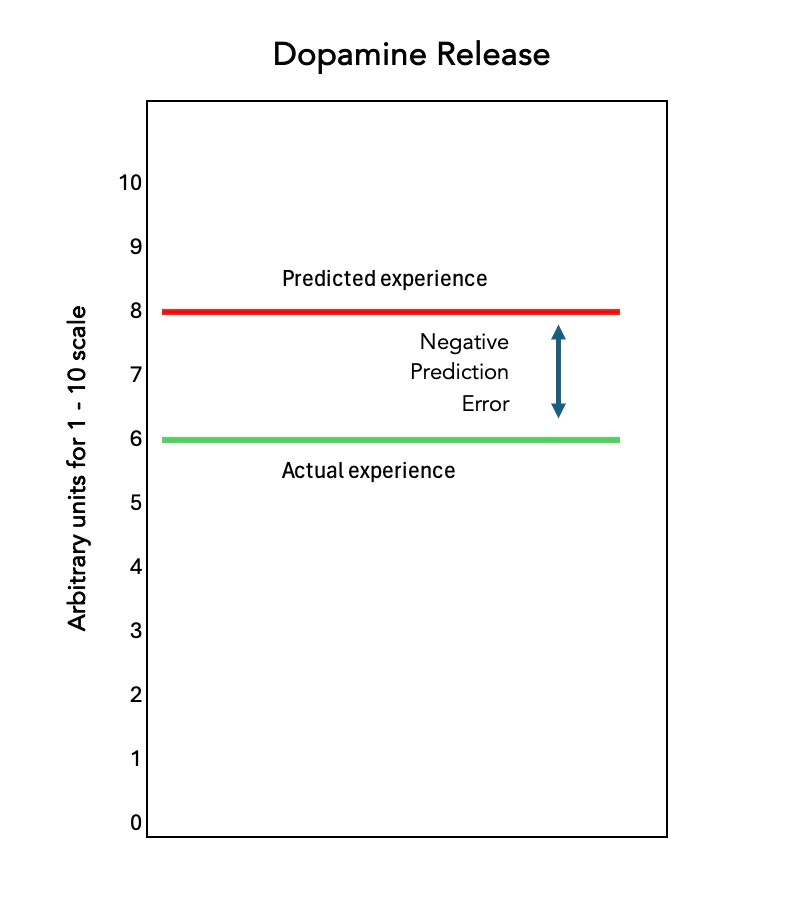
Imagine you have scale starting at 0 with a high of 10. Dopamine is released in anticipation of a future event - it creates an expected level of pleasure.
The scale relates to how much you are looking forward to something - in this case, the Hot Spring experience. As more and more people told me to go there, the higher my expectation of pleasure became. On the scale it was probably an 8/10.
And then my actual experience was still good but not amazing. A 6/10 on the dopamine scale.
The gap between expectation and reality on the scale is 8 - 6=2.
There is a negative reward prediction error of 2, and this mismatch creates a feeling of disappointment.
The reward prediction error means the difference between the reward I get and the reward that was predicted.
It works in the negative sense as well. Once a month I take my ice bath to the beach. Its is a very informal set-up, no booking is required. You simply arrive, put your name on the time slot. And then you will get my full attention to guide you through the scary event.
Some people are curious but very, very apprehensive. It is normal to be scared of an ice bath - our whole being object to the immersion in ice water. Your primitive brain is on full alarm. So they predict that the experience will be terrible!
Using the scale example above, they predict ‘Ice Bath Horrible-ness’ at 8/10. And then, with my guidance, they find that they can stay in for 3 minutes, are able to control their breathing and stay calm.
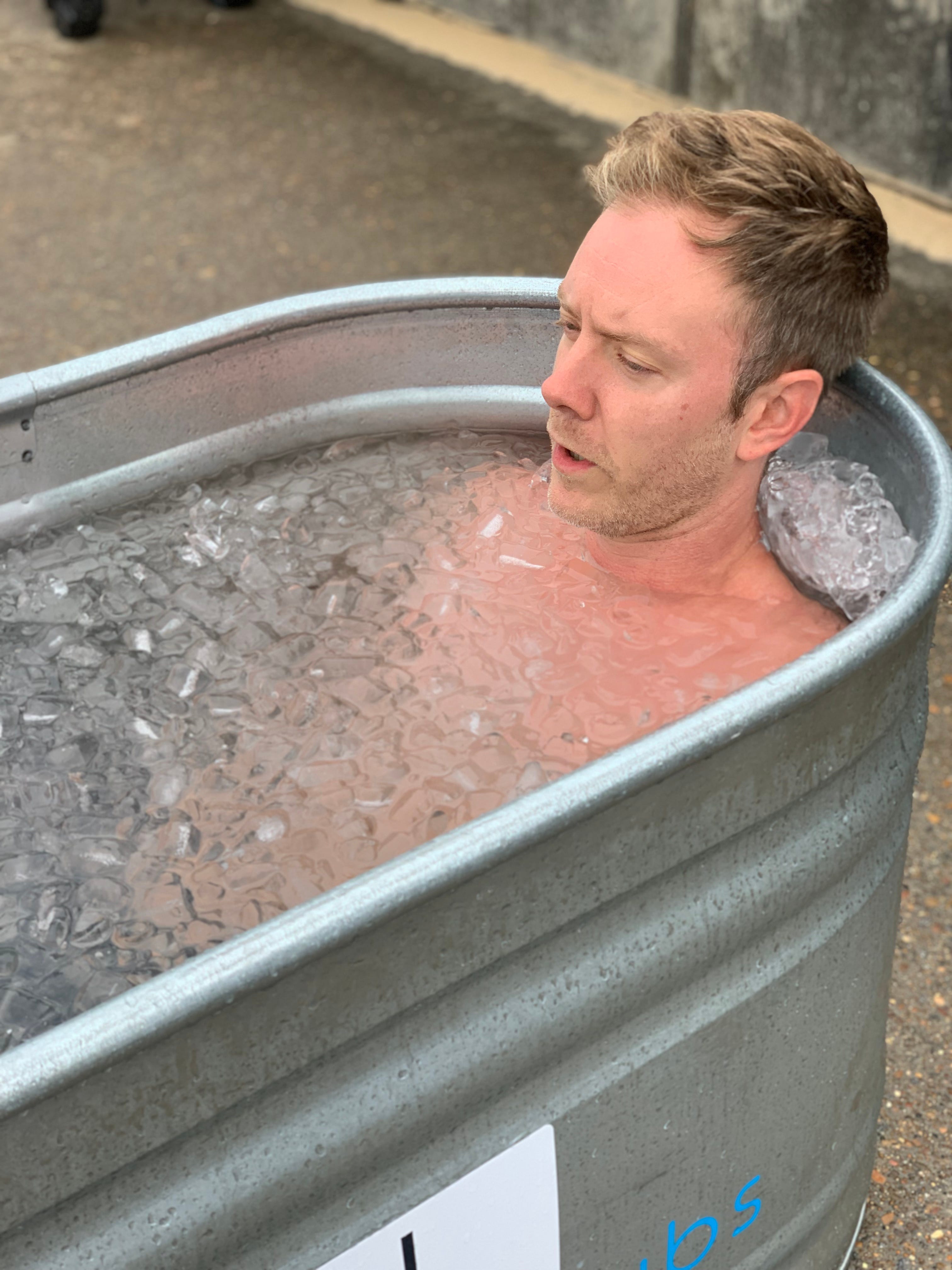
The actual experience rates at 6/10. Still not great - but not as bad as they predicted. In this case there is a Positive Reward Prediction Error of 2.
A pleasant surprise is called a Positive Reward Prediction Error.
Closing thoughts
You could very well make a case for always setting low expectations to never experience disappointment. But alas, to live a fulfilling life, you are meant to have the full spectrum of emotions.
It helps too understand why we are feeling pleasantly surprised and disappointed with life’s experiences.
The dopamine prediction error, helps us survive and learn.
Schultz W. Dopamine reward prediction error coding. Dialogues Clin Neurosci. 2016 Mar;18(1):23-32. doi: 10.31887/DCNS.2016.18.1/wschultz. PMID: 27069377; PMCID: PMC4826767.
I liked your explanation. I also agree that you shouldn’t set expectations low just so that you avoid disappointment. I find it’s better not to focus on expectations, but instead to have an open mind.