

Metabolism is constant throughout adult life. Well, until you are 60y.
“I gained weight in my 40s because my metabolism slowed down”.
Like me, you will no doubt have heard this many times. Maybe you have even said this.
First, a few definitions
We need energy to do things: sleeping, sitting, walking, exercise and thinking. How much energy you need per day is influenced by sex, body size and what you do. Energy requirement is estimated by the formula BMR x PA = TDEE.
BMR - Basal Metabolic Rate. It is the minimum calories your body burns just to be alive - if you are asleep all the time.
PA - Physical Activity factor.
TDEE or TEE - Total (Daily) Energy Expenditure is the energy used in a typical day including
Use this online calculator.
There are a few recognised formulas behind the BMR calculation. None are perfect. They will give you a good idea of where to start. I generally use the Revised Harris-Benedict equation.
Between 50-70% of energy is used at rest … doing nothing. Your brain uses 20% of BMR!
It is best to be a bit pessimistic when you choose the Physical Activity factor. If you do no exercise the factor is 1.2. Professional athletes of people with a physical job like bricklaying have a factor of 1.9. If your job is mostly sitting, but you do 60 minutes of exercise most days, use the average of (1.2 + 1.5)/2 = 1.35.

The research
It is a common belief that metabolism slows down as we get older and that is the reason for weight gain.
Herman Pontzer et al. (2021)1 analysed a large database of over 6000 people to investigate this claim.
Not surprisingly, they found that you need more energy if you are a bigger person.
Specifically, energy requirements go up in a power-law manner (almost linear fashion) with fat-free mass (bone, muscle and water).
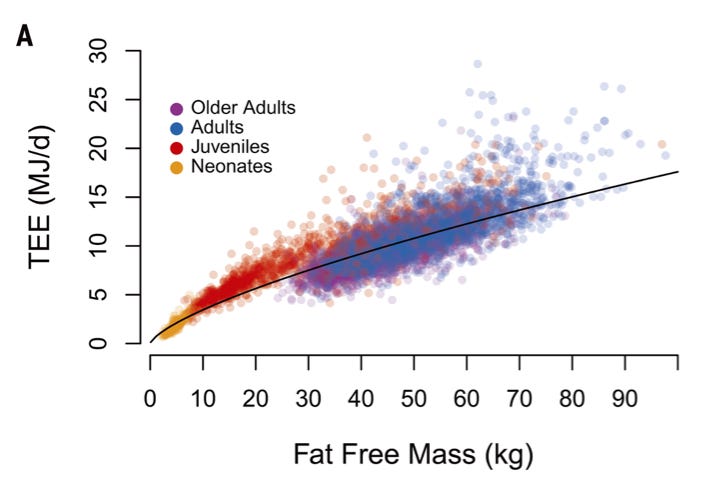
Regression analysis was therefore used to adjusted for body size to isolate the effect of age. Using complicated maths and stats, energy expenditures were normalised to 100% for comparison purposes. In other words: 100% indicates expected expenditure give a certain fat-free and fat mass, 120% indicates 20% above expected and so on.
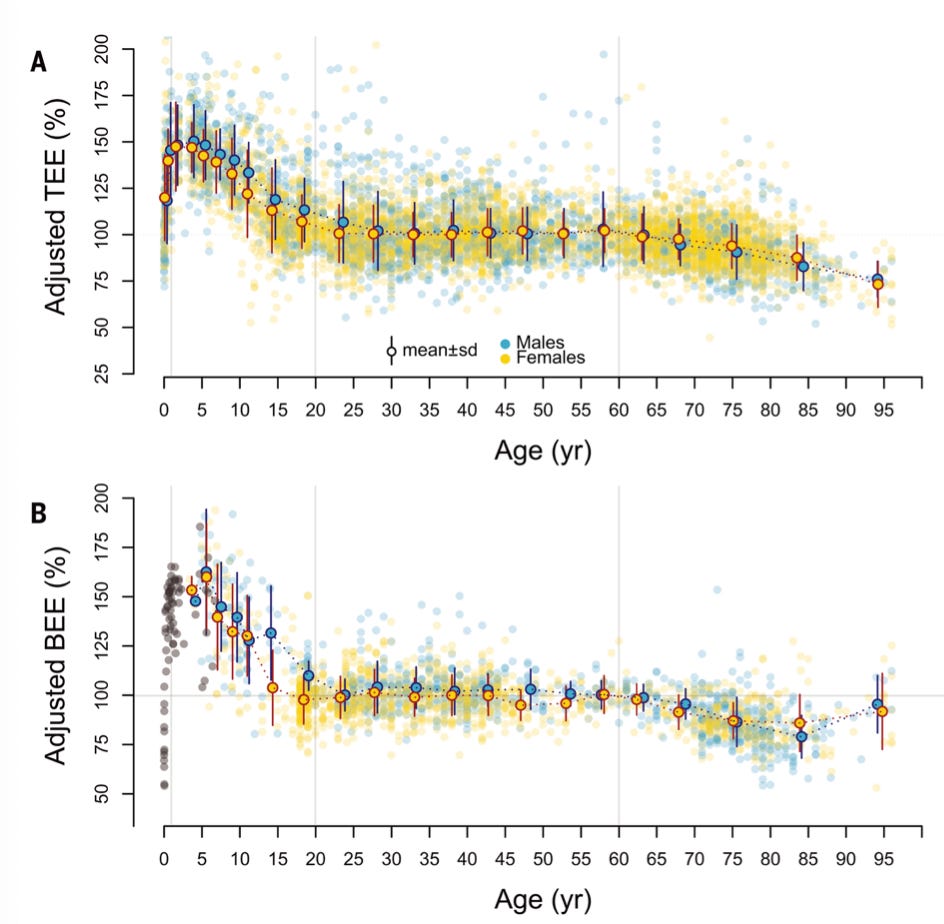
The analysis showed that total and basal expenditure and fat-free mass were all stable from ages 20 to 60 years. This was true for males and females.
As you can see from the figure below, energy expenditure begin to decline from the age of 60 years. What is important to understand is that the decline is in line with a decline in fat free mass. In other words, you metabolism slows down as you lose muscle mass when you get older.
This also implies, that your metabolism will decline less if you maintain your muscle mass as you age.
The effect of ageing
The analysis also showed that from the age of 60 years there is a decline in energy expenditure of 0.7% per year independent of the accompanying muscle loss.
Metabolism slows down by 0.7% per year from the age of 60 years as a result of ageing.
By the age of 90+ years, total daily energy requirements are ~26% below that of a 50 year old.
What this means for you
The most important take away is - maintain your muscles mass at all cost. You muscles are an energy sink. It is probably the only thing that we can influence to prevent metabolism decline as we age.
Don’t lose muscle mass. This means strength and power training. Go to the gym lift and move heavy things. Never stop. It is not too late to start - people build muscle at any age, even in their 80s.2
Weight gain is most likely due to moving less. Less likely to eating more.
As we get older, we typically eat the same amount of calories for many years. However, we tend to move less. And I don’t mean formal, organised exercise.
Just watching young children and teens - they move all the time. It can be quite exhausting just to watch!
Walking 10 minutes after meals will not only increase the “calories out” but also help digestion. Walking after dinner also help you sleep better.
Take the stairs whenever you can.
Park the car the furthest away from where you need to be.
Do 10 air squats 4 times a day.
Stand up when you read emails
Throw ball with the kids - or a friend
And of course, you may need to eat a bit less.
Have a good look at your plate. If dishing up for yourself - reduce the portion sizes a little bit. It takes a while to get used to, but your brain will learn to recognise a “smaller plate of food as the new normal”.
It is human nature to blame results on things that happen to us, outside our control - like getting older. It is harder to accept the reality that we are unconsciously responsible for the things we do not like and that it is in our ability to change. Strength train, moving more and eating less is a life-long challenging commitment.
Keeping our weight stable as we age is a life-long battle for all of us. Pay attention everyday.
Thank you for reading :)
Reference:
Herman Pontzer et al., Daily energy expenditure through the human life course. Science373,808-812(2021). DOI:10.1126/science.abe5017
Marzuca-Nassr GN, Alegría-Molina A, SanMartín-Calísto Y, et al. Muscle Mass and Strength Gains Following Resistance Exercise Training in Older Adults 65–75 Years and Older Adults Above 85 Years. International Journal of Sport Nutrition and Exercise Metabolism. 2024;34(1):11-19. doi:10.1123/ijsnem.2023-0087