

Podcast recommendation
The Peter Attia Drive Podcast with Dr Marty Makary, episode #317 dated September 16, 2024. Dr Makary is the chief of Islet Transplant Surgery at John Hopkins and has received numerous awards. He is a passionate public health researcher striving to improve health care. He writes regularly for The Wall Street Journal and is known for his book The Price We Pay. His new book is called Blind Spots.
One of the most interesting things discussed on the podcast is that recent evidence show that most ‘ovarian’ cancer actually originates in the fallopian tubes12. What has previously been described as ovarian cancer is actually fallopian tube cancer. This is really good news. Practically, this means that removing the fallopian tubes instead of just ‘tying the tubes’ will reduce the risk of ovarian cancer.
They also discuss:
treatment of appendicitis
peanut allergy epidemic
misunderstanding HRT and breast cancer
antibiotic use
Snoring & Stroke
When it comes to our health, we each have a unique fear. For some it is cancer, for others a heart attack. For me: it is losing my brain function and cognition.
What are you scared of? I would love it if you could comment below - I am genuinely interested.
When we are younger, the biggest risk for losing brain function is from a traumatic brain injury (TBI) including concussion. As we get older, the possibility of stroke or dementia (including Alzheimers) increases. If humans made all decisions purely on logic instead of emotion, we would focus on taking actions that minimise the risks of what we fear.
Stroke
Interruption of blood flow to the brain is called a stroke. This can occur when a blood clot blocks a blood vessel (ischaemic stroke) or when a blood vessel breaks (hemorrhagic stroke) and the blood flows into the brain area. A mini (clot) stroke is called a Transient Ischaemic Attack (TIA) and symptoms disappear within 24 hours.
The most prominent risk factor for stroke is high blood pressure.
Other modifiable risk factors include type 2 diabetes, high cholesterol, atrial fibrillation, blood disorders and family history. Stroke risk is higher in males (x1.4) and in people over 65 years.
Statistics for USA and Australia show that stroke is the leading cause of disability and 5th and 3rd leading cause of death3. A staggering 3.4 million people are predicted to have a stroke in the USA by 2030. In Australia, 67 900 people presented to the hospital with stroke in 2020 - see figure below. You can find more scary statistics at the Brain Foundation or AIHW sites.
The good news is that treatment for stroke is improving leading to lower mortality as a result of stroke (1).


Snoring
Snoring is essentially a turbulence-vibration problem. This means either the opening is too small or the airflow is too fast.
To illustrate: imagine you are inside your house and you can hear a high pitched whistling sound as the wind outside is coming in through a tiny gap in the window. The window is rattling (vibrating) in strong winds. To solve this sound problem, you can open the window - make the opening bigger. The sound will also go away when the wind outside slows down.
Similarly, snoring is caused by soft tissue vibrating in the back of the throat. And similar to the window, snoring will be less if the airway opening is bigger or the breathing rate slows down.
When the soft tissue collapse completely blocks the throat and breathing stops, it is called obstructive sleep apnea (OSA). The increased risk for stroke associated with apnea is well recognised in many studies4 5. Many people who snore do NOT have OSA.
Snoring itself as a risk factor for stroke is often overlooked in the clinical setting.
Snoring is the most common sleep disorder. Approximately 30% of adults snore!6
Research evidence for snoring independent of OSA as a risk factor for stroke is less robust. A small study of 400 participants in 2012 7 found no association between snoring and increased risk for stroke. A meta-analysis (2014) of 8 cohort studies8 showed a significant increase in stroke risk from snoring. Though the authors admit that it could not distinguish if the increased risk was due to OSA or snoring.
Another meta-analysis by Li et al. (2015) comprising 6 cohort studies, confirmed modest but statistically significant increase in stroke risk from snoring as a stand alone factor. The positive relationship remained after data was adjusted for cardiovascular risk factors.
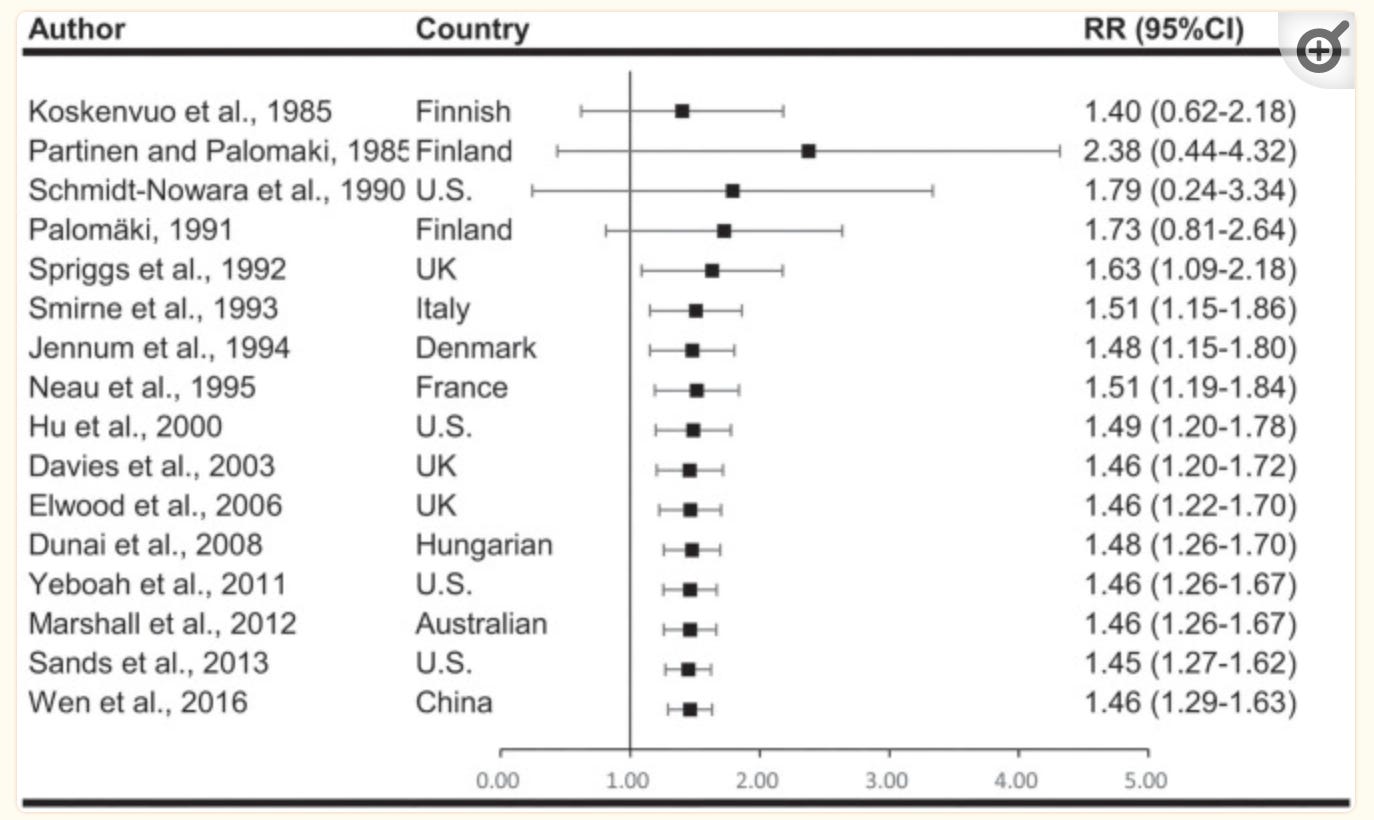
In 2021, Bai et al.9 performed a systematic review and meta-analysis of observational studies assessing the link between snoring and risk of stroke. A total of 16 articles were included with 3 598 stroke patients and 145 901 participants.
The researchers used a random-effects model to find summary relative risks (RRs). A relative risk of 1.5 means that there is a 50% higher chance of something. In this case the combined RR is 1.46.
The analysis showed that snoring is associated with a 46% increased relative risk of stroke - compared to your absolute risk of getting a stroke.
The figure below is for the stats nerds and shows the pooled results of the meta-analyses included the date (RR, 1.46; 95%CI, 1.29–1.63; p < 0.001).
For the non-stats nerds: the plot shows that the data midpoints for all the studies are clustered around 1.46 - in increased relative risk of 46%.
IMPORTANT note about relative risk vs absolute risk. The absolute risk for stroke is the likelihood of a stroke within a specified time period. The relative risk shows the difference (increase or decrease) a factor (snoring) makes to the absolute risk (stroke). The lifetime absolute risk of stroke is ~16%, or stated as 1 in 6, for middle aged adults 10.
Snoring increase the absolute risk of 16% by 46%, to the equivalent of 23% absolute risk (16 x 46% = 23).
How does snoring increase stroke risk
It is difficult to tease out whether snoring independently increase stroke risk or whether the relationship is confounded by the traditional stroke risk factors of OSA, diabetes and cardiovascular problems.
The biological mechanisms underlying the snoring-stroke association are not completely understood.
One theory is that snoring contributes to atherosclerosis. Sleep apnea leads to lower oxygen levels to the brain and consequently to oxidative stress and inflammation. Further downstream complications include insulin resistance, endothelial dysfunction, cholesterol and lipid metabolism dysfunction, and high blood pressure. As mentioned above, these factors predispose to stroke.
A novel hypothesis is that the vibration from snoring may be another potential mechanism. A small animal study showed that vibration of nearby tissue induced damage to the carotid artery blood vessel cells11. Prolonged exposure to vibration from hand-held tools leads to neural and blood vessel injury evidenced in thinning of the blood vessel wall and increased platelet activation12. In both studies, the ability of blood vessels to relax was compromised. If blood vessels cannot relax sufficiently, blood pressure will rise.
What can you do?
The usual suspects come into play when it comes to reducing the risk for stroke: stay active, eat well, quit smoking and avoid alcohol. You can read more at CDC Stroke.
Assess your stroke risk with a quick test by The Stroke Foundation Australia.
Lifestyle changes to reduce snoring include:
lose weight
avoid alcohol
treating nasal congestion
avoid sleeping on your back
Interventions that may help:
Dental mouthpieces (similar to a mouth guard) - to bring the jaw forward and reduce soft tissue collapse
CPAP machine that pumps pressurised air into the airway
Surgery for adenoids, tonsils, nasal polyps and septum correction
Uvulopalatopharyngoplasty - surgery to remove excess tissue from the throat
Maxillomandibular advancement (MMA) - radical surgery moving the upper and lower jaws
Radiofrequency to shrink the tissue in the soft palate, tongue or nose.
PLEASE seek help if your child snores.
A less radical options are nasal dilator strips, or special pillows.


Taping your mouth or chin straps might help if your snoring is due to sleeping with your mouth open. It will not help if you snore with your mouth closed. Mouth tape options: Respire Sleep Strips, Myotape and others. Mouth taping is not without risk, please seek professional advice.
A huge elephant in the room is retraining your breathing.
Many people can benefit from breath retraining. As mentioned above - if the rate of airflow is slower, the turbulence will be less, and hence the snoring will stop. There are a number of aspects involved in breath training including good breathing mechanics, CO2 sensitivity, over-breathing and chronic stress. You can learn to breathe slower. Find a breath coach and invest in your health.
Snoring is big business. There are a huge number of items available that claim to reduce snoring. It is worth trying to find something that works for you. Improving sleep quality will dramatically improve your energy levels and quality of life.

Note: A meta-analysis collects the data from a number of studies and to determine the overall findings and magnitude of effect sizes. The more similar the results, the more likely the findings are to be true.
Note: I have no affiliation for any of the products mentioned.
References:
Perets R, Muto KW, Bijron JG, Poole BB, Chin KT, Kwak S, Chen JYH, Karst AM, Setlur SR, Hirsch MS, Crum CP, Dinulescu DM, Drapkin R: Transformation of the fallopian tube secretory epithelium leads to high-grade serous ovarian cancer in Brca;Tp53;Pten models. *Highlighted in Nature Reviews Cancer, Cancer Discovery, and Cancer Research. Cancer Cell 24: 751-65, Dec 2013.
Kyo S, Ishikawa N, Nakamura K, Nakayama K. The fallopian tube as origin of ovarian cancer: Change of diagnostic and preventive strategies. Cancer Med. 2020 Jan;9(2):421-431. doi: 10.1002/cam4.2725. Epub 2019 Nov 25. PMID: 31769234; PMCID: PMC6970023.
Boehme AK, Esenwa C, Elkind MS. Stroke Risk Factors, Genetics, and Prevention. Circ Res. 2017 Feb 3;120(3):472-495. doi: 10.1161/CIRCRESAHA.116.308398. PMID: 28154098; PMCID: PMC5321635.
Munoz R, Duran-Cantolla J, Martínez-Vila E, Gallego J, Rubio R, Aizpuru F, De La Torre G. Severe sleep apnea and risk of ischemic stroke in the elderly. Stroke. 2006 Sep;37(9):2317-21. doi: 10.1161/01.STR.0000236560.15735.0f. Epub 2006 Aug 3. PMID: 16888274.
Yaggi HK, Concato J, Kernan WN, Lichtman JH, Brass LM, Mohsenin V. Obstructive sleep apnea as a risk factor for stroke and death. N Engl J Med. 2005 Nov 10;353(19):2034-41. doi: 10.1056/NEJMoa043104. PMID: 16282178.
Li M, Li K, Zhang XW, Hou WS, Tang ZY. Habitual snoring and risk of stroke: A meta-analysis of prospective studies. Int J Cardiol. 2015 Apr 15;185:46-9. doi: 10.1016/j.ijcard.2015.03.112. Epub 2015 Mar 10. PMID: 25782049.
Marshall NS, Wong KK, Cullen SR, Knuiman MW, Grunstein RR. Snoring is not associated with all-cause mortality, incident cardiovascular disease, or stroke in the Busselton Health Study. Sleep. 2012 Sep 1;35(9):1235-40. doi: 10.5665/sleep.2076. PMID: 22942501; PMCID: PMC3413800.
Li D, Liu D, Wang X, He D. Self-reported habitual snoring and risk of cardiovascular disease and all-cause mortality. Atherosclerosis. 2014 Jul;235(1):189-95. doi: 10.1016/j.atherosclerosis.2014.04.031. Epub 2014 May 6. PMID: 24854629.
Bai J, He B, Wang N, Chen Y, Liu J, Wang H, Liu D. Snoring Is Associated With Increased Risk of Stroke: A Cumulative Meta-Analysis. Front Neurol. 2021 Apr 1;12:574649. doi: 10.3389/fneur.2021.574649. PMID: 33868139; PMCID: PMC8047148.
Seshadri S, Beiser A, Kelly-Hayes M, Kase CS, Au R, Kannel WB, Wolf PA. The lifetime risk of stroke: estimates from the Framingham Study. Stroke. 2006 Feb;37(2):345-50. doi: 10.1161/01.STR.0000199613.38911.b2. Epub 2006 Jan 5. PMID: 16397184.
Cho JG, Witting PK, Verma M, Wu BJ, Shanu A, Kairaitis K, Amis TC, Wheatley JR. Tissue vibration induces carotid artery endothelial dysfunction: a mechanism linking snoring and carotid atherosclerosis? Sleep. 2011 Jun 1;34(6):751-7. doi: 10.5665/SLEEP.1042. PMID: 21629363; PMCID: PMC3099496.
Curry BD, Bain JL, Yan JG, Zhang LL, Yamaguchi M, Matloub HS, Riley DA. Vibration injury damages arterial endothelial cells. Muscle Nerve. 2002 Apr;25(4):527-34. doi: 10.1002/mus.10058. PMID: 11932970.