

Podcast recommendation
The Diary of a CEO episode 11 November 2024 with Dr. Victoria Sampson. She is a functional dentist and researcher. Oral health has been linked to heart disease, cancer, diabetes, stroke and respiratory conditions. Watch it on Youtube or wherever you get your podcasts, Spotify link.
I learnt to stop rinsing after brushing my teeth - just spit out the excess toothpaste.
This is a technical piece to lay the foundations for future posts.
A case of long-term iron deficiency
“Stephanie” came to my clinic a few years ago. She was only 20 at the time and had been struggling with iron deficiency since she was 16. For many women, heavy menstruation is often the culprit. It did not appear to be the case here. So we talked about diet. Like many young people with she experimented with her diet and was eating less and less animal proteins. This in itself does not necessarily lead to low iron status, but it doesn’t help. We also talked about her supplementation strategy - she has received an iron infusion more than once. Constipation and other unpleasant side effects from oral iron supplementation are the main reasons why people stop taking them.
During our conversation, a few other clues lead to me to send her for a Coeliac Disease gene test. Her results were positive for HLA-DQ8 but negative for HLA-DQ2. At least one of these genes is necessary for Coeliac Disease to develop. By following a gluten free diet and a course of supplements, Stephanie successfully restored her iron status.
What is important to understand here, is that iron deficiency can have many causes.
Iron deficiency is rising in Australia, with young women aged 18-30 the worst affected. For the most part this is due to inadequate intake of dietary iron. Iron deficiency is a huge problem - one that I see frequently in my clinic. Women in particular struggle with this, some for many years.
Men can have iron deficiency too. This can be missed since few doctors will test iron status in men.
Iron is important for several key functions in the body including, oxygen transport, energy metabolism, cognitive function and optimal immune function.
Signs & Symptoms of Iron-deficiency Anaemia
The American Society of Hematology lists the following:
Fatigue or lack of energy
Shortness of breath, especially with exercise or exertion
Rapid heartbeat, palpitations
Headache
Pale skin and eyelids
Generalised weakness
Brittle nails and hair loss
Cold hands and feet
Depression1
Anxiety
Very short overview of Iron metabolism
The complexity of iron metabolism keeps researchers very busy - over 152,000 studies are published on PubMed when the term “iron metabolism” is searched. Here, I will keep to the basics:
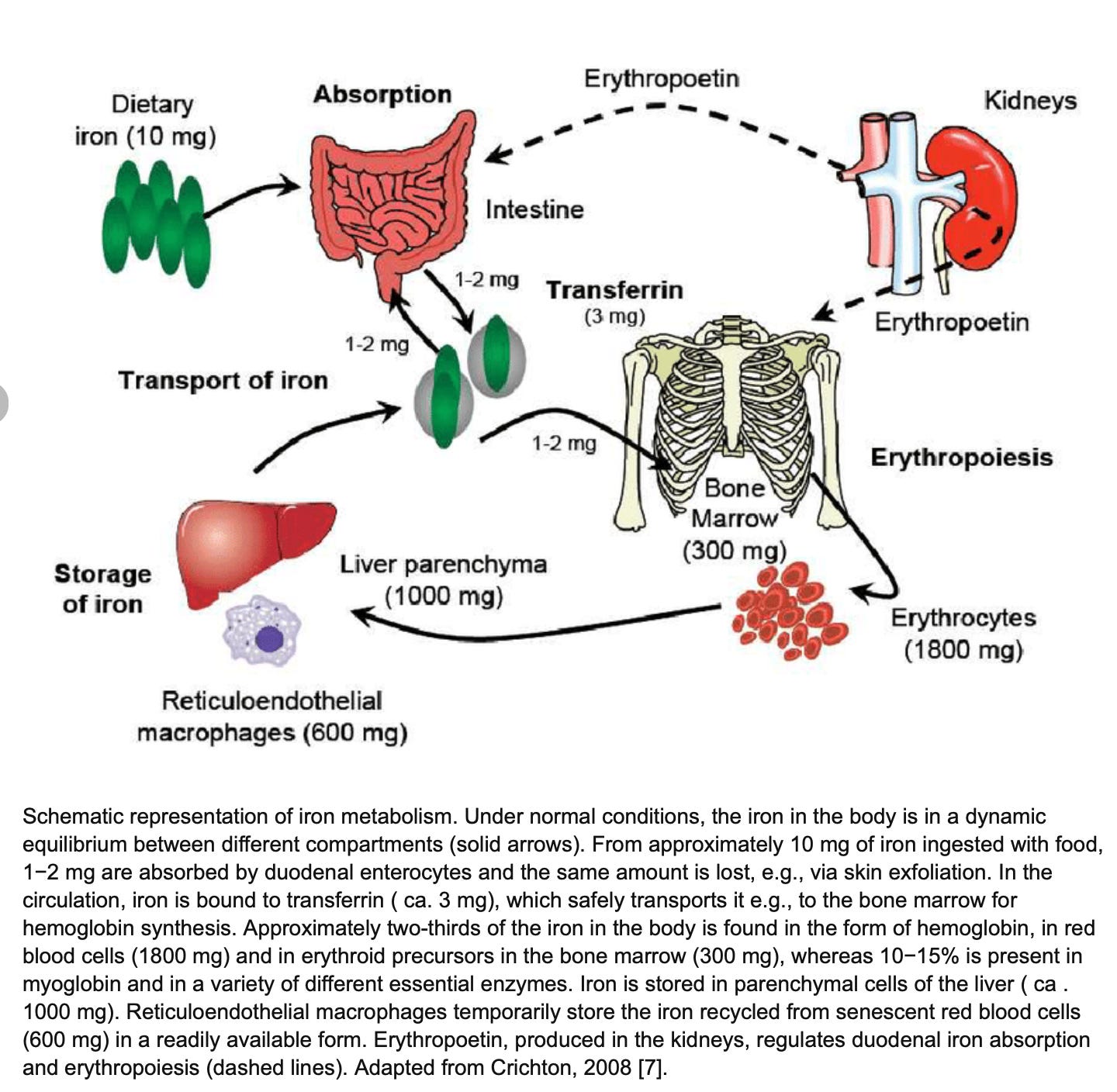
Intake → absorption → transport → usage → recycling → loss
Intake
Dietary iron from animal sources is called heme iron (Fe2+) and not surprisingly it is the highest in liver, kidneys and then muscle meats. The iron in plant foods is called non-heme iron (Fe3+). Non-heme iron is changed into heme iron by an enzyme attached to the intestinal cell before it can be taken up into the cell.
Absorption
Iron is absorbed from the foods we eat by the enterocytes (cells) in the intestine. Some iron is stored in the enterocytes as ferritin, most is released into blood circulation. There is a special gate-like molecule called, ferroportin, through which iron is released from inside the intestinal cell to the bloodstream.
Transport
From there, the iron atoms hitch a ride with transport proteins called transferrin, to the bone marrow (and some to other cells).
Usage
In the bone marrow, the iron is used to make the haemoglobin protein molecules, which are incorporated into new red blood cells (erythrocytes). Red blood cells are transported in the bloodstream, where the oxygen bound to the haemoglobin is delivered to cells.
Recycling
On average red blood cells live 90-120 days. Old or damaged red blood cells are picked up by macrophages (a pacman-type of immune cell that is good at picking up debris). Iron is temporarily stored inside macrophages and then transported to the liver.
Storage
The main site of iron storage is the liver and is called ferritin. Between 300 to 1000 mg iron is found in the liver, ready for recycling back to the bone marrow. Many cells are capable of storing a little bit of iron for its own use.
Control
Iron has good and bad functions in the body. Hence the iron levels are controlled through a network of proteins to regulate absorption, storage, recycling and use.
When there is an increased demand for oxygen - as is the case for sport or at high altitude - the kidneys release erythropoetin (EPO) to stimulate increased absorption of iron and increased synthesis of new red blood cells. If you inject EPO, you get more red blood cells, increased oxygen delivery and improved sport performance. It is no surprise that exogenous (injectable) EPO is banned in elite sports.
Too much iron in the blood is toxic, hence the liver regulates the amount of iron that can be absorbed - typically 1-4mg of elemental iron per day.
Iron is highly reactive - think of how easily rust is formed - and forms reactive oxygen species (ROS) or lipid peroxides (rancid fat). These molecules damage other biological structures including lipids (fat), proteins and nucleic acids and lead to cell and tissue damage or death2.
When we have to high levels of some minerals like potassium, sodium or calcium they can be excreted in the urine, faeces or sweat. The human body does not have a controlled way of getting rid of excess iron. We do lose iron with blood loss - most of the time this is not in a controlled method.
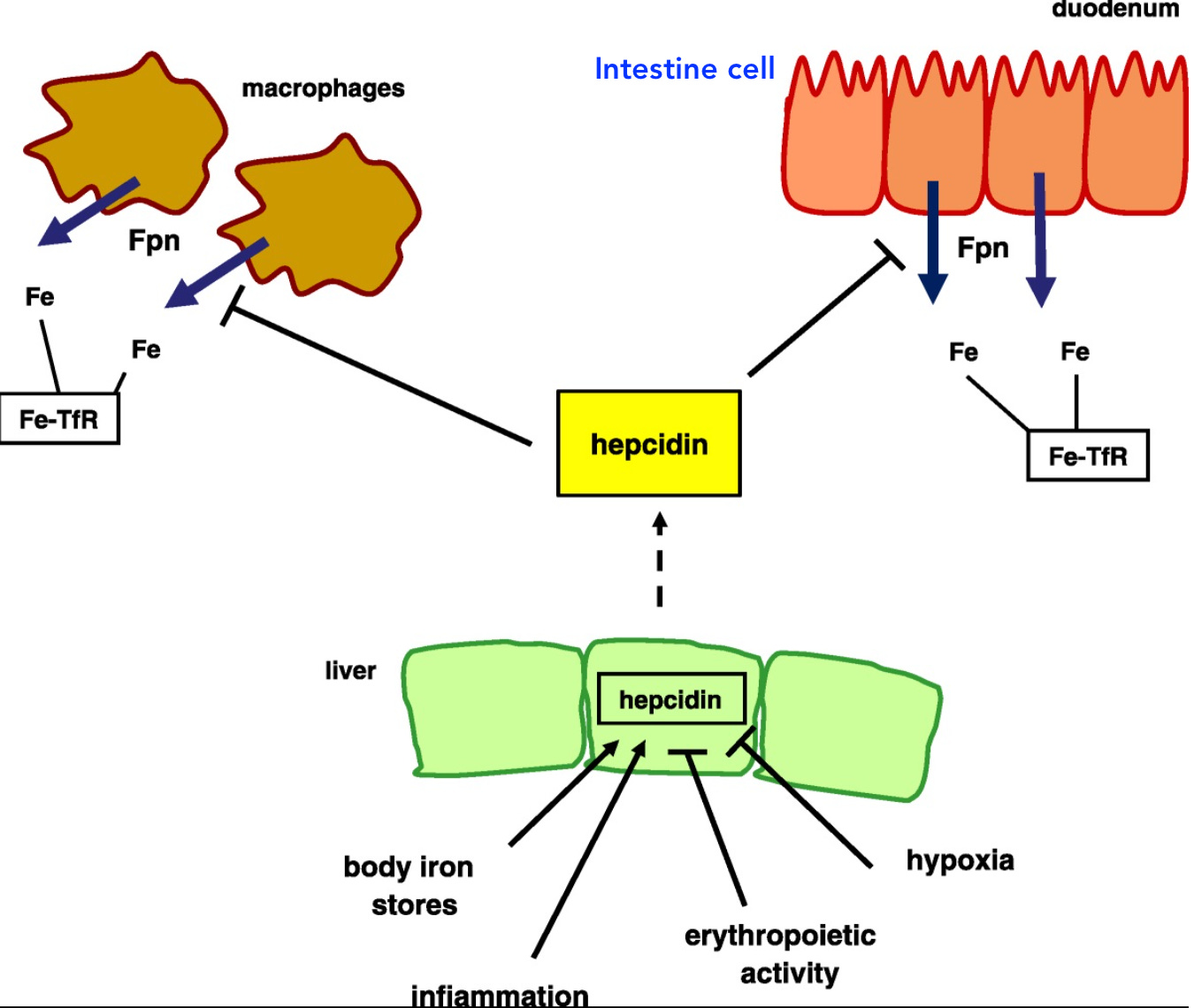
The molecule hepcidin maintains the body iron balance.
When iron levels in the blood is too high, the liver release a molecule called hepcidin to control iron absorption. Infection or inflammation also increase the release of hepcidin - serum (blood) levels of iron can be low when you are sick.
Hepcidin degrades the ferroportin ‘gate-complex’ on the intestinal cells, liver cells, and macrophages. Without the ferroportin-gate, iron cannot be released into the blood.
When iron levels are low, hepcidin levels are suppressed and this leads to higher absorption and release of stored iron. Low levels of oxygen and increased synthesis of new red blood cells, also suppress hepcidin to facilitate higher absorption and release from storage.
Haemoglobin
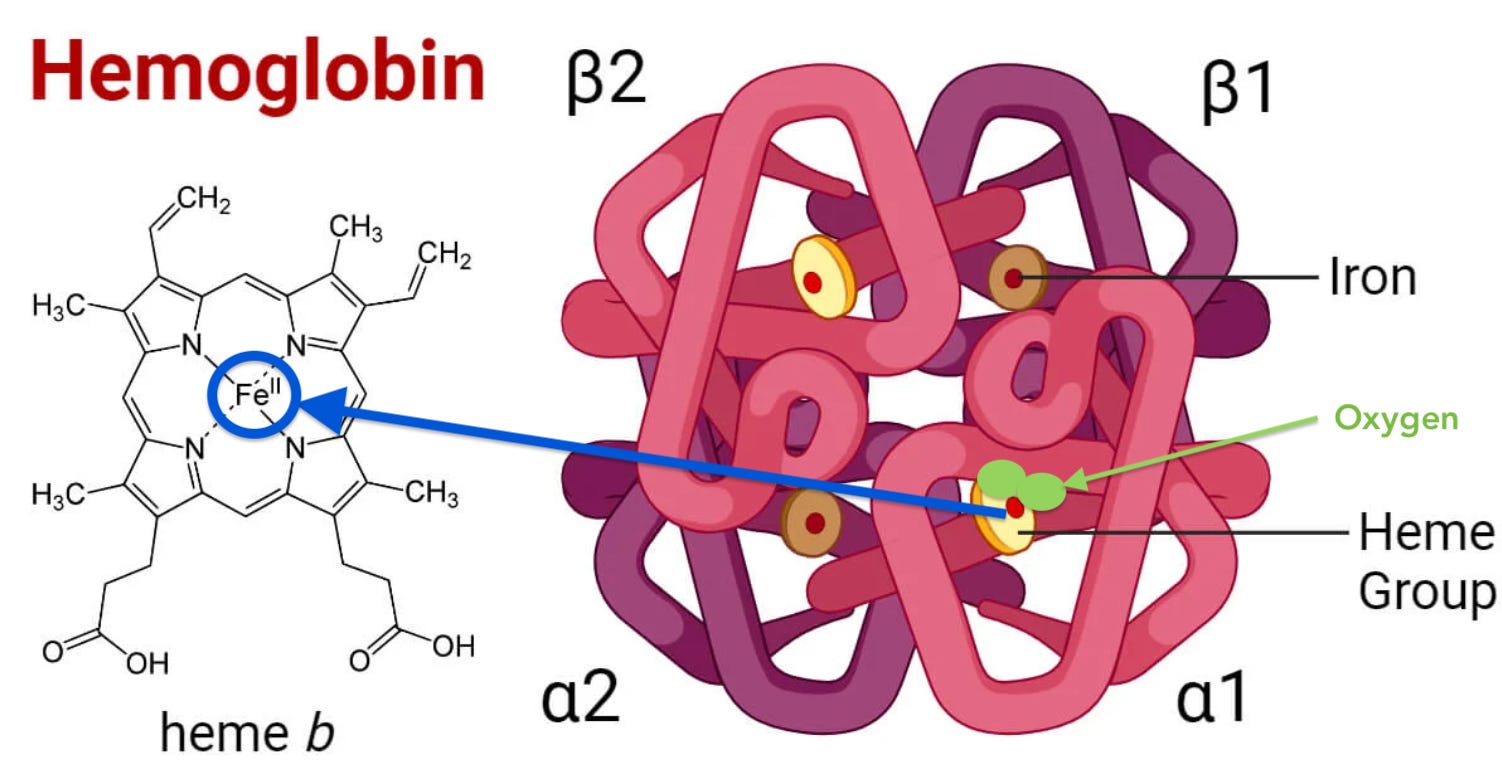
The iron atom (Fe2+) makes the haemoglobin structure stable. Four subunits (2x alpha and 2x beta chains) are combined to make one haemoglobin protein molecule. Every iron atom can (loosely) bind to an oxygen molecule (O2). So there are a maximum of 4 oxygen molecules in every haemoglobin. There are about 270 million haemoglobin molecules in every red blood cell and roughly 2.2-3.3 trillion red blood cells in adults.
Oxygen is used in many biological reactions including making energy. Red blood cells are transported in the bloodstream. Where oxygen is required it will be released from the haemoglobin and diffuse from the red blood cell into the adjacent cell where it is used. More than 60% of iron in the body is found in haemoglobin and in bone marrow.
Iron is also used as cofactor (helper) by many enzymes in energy production, making new DNA and amino acids, hormone synthesis, immune function and to make myoglobin. Myoglobin is found in muscle and is an oxygen storage and releasing molecule.
This concludes Part I.
Look out for the next posts where:
Part II covers Iron Losses, Malabsorption, Intake, Needs and Testing.
Part III covers Sports Anemia.
Part IV covers Iron overload
Thank you for reading this far.
This was highly technical. I tried to make it as simple as possible with pictures! There are nuances in iron metabolism that I have ignored here to make the reading easier. If you have any questions please feel free to comment, I would love to hear from you.
About Estelle
Estelle’s early career was in financial modelling and reporting in the mining industry. Estelle’s growing interest in health and medical science led to a change direction and she completed a Bachelor of Biomedical Science at the University of Newcastle in 2017. To use this knowledge in a more practical and client focus way, she completed her Bachelor of Health Science Nutrition & Dietetic Medicine in 2020. She is also a qualified breath coach. These formal qualifications inform her philosophy about health, nutrition, breathing and influence her clinical focus.
Reference:
Arshad H, Arshad A, Hafiz MY, Muhammad G, Khatri S, Arain F. Psychiatric Manifestations of Iron Deficiency Anemia-A Literature Review. Eur Psychiatry. 2023 Jul 19;66(Suppl 1):S243–4. doi: 10.1192/j.eurpsy.2023.560. PMCID: PMC10595923.
Buratti, P; Gammella, E; Rybinska, I; Cairo, G; Recalcati, S. Recent Advances in Iron Metabolism: Relevance for Health, Exercise, and Performance. Medicine & Science in Sports & Exercise 47(8):p 1596-1604, August 2015. | DOI: 10.1249/MSS.0000000000000593