

It is the beginning of a new year. Every January people all over the world commit to a goal for the next 12 months, something challenging and of course intrinsically rewarding. Not surprising to any of you, losing weight and doing more exercise makes the top ten of yearly Resolutions. USA statistics show 15% of people aim to lose weight, 17% exercise more and 19% strive to eat healthier. Similarly, almost 50% of Australians wanted to improve their physical health in 2024.
Weight loss research tells us that losing weight is difficult, most people succeed in losing some if not all of their target weight.
Yet, more than 60% of people will regain what they have lost in the following 2-5 years 1.
Weight loss maintenance is a huge field of interest.
Over last few weeks I have been contemplating why some people manage to keep their weight stable, while others struggle with an endless cycle of weight loss and regain.
It is tempting to think that thin people can eat whatever they want without change in weight. Are they are just lucky to be born with good genes?
And for a very few, that might be the case - though I would wager that their total caloric input stays within their normal range without their conscious effort. These people for the most part, don’t snack and they don’t eat when they are not hungry. And they are more active (not exercise per se, just busy) than other people. One “always-skinny” person I know, walks at least 60 minutes everyday. And she walks very fast, I can’t keep up. I have never seen her snack. Another is always on the go - he never sits still.
What I think is under-appreciated is that a lot people with apparent stable weight, have in fact, struggled for many years.
For most people (including me) keeping weight stable is a constant, never-ending endeavour. It involves making many, tiny decisions throughout the day that keeps them on track.
However, for them it is not mentally exhausting. It appears unconscious and effortless. In other words - many of their food and exercise behaviours are habits.
HOWEVER, it is not all automatic.
It takes a conscious decision to put your exercise clothes out the night before. It takes a conscious decision to eat fruit instead of cake. It takes a conscious decision to drink water instead of a soft drink.
Tiny daily decisions
For the past few weeks, I have been observing my friends and people around me eating. What is on their plate? How much are they eating?
Some of my observations:
Eating less the day after a high calorie day. periods of higher calorie intake are followed by one or more days of food restriction.
Smaller portions.
Having an upper tolerance limit for weight increase before they take action - typically 2kg. In the words of my friend Meg; “I do not let it get out of control.”
Drinks are mostly water and black coffee or tea.
Skip meals if the one before was excessive.
Snacks are small or lower calorie or shared
Only eat something indulgent if they truly like it - not because it is there. Another friend Jeni calls it “don’t waste calories on something you don’t like that much.”
Do not have snacks in house. You can’t eat what you don’t have.
Weigh regularly, some daily, others weekly.
Walking deliberately, especially after meals.
Being able to recognise when the food presented was too much and not finishing the plate.
Eating is not mindless - how much and what goes on their plate is evaluated every time. They might order cake with a serving of ice cream for desert some days but the calorie adjustment can be a smaller main course.
Exercise is prepaid and pre-booked.
Exercise clothes are laid out the night before.
Adjust meals for training - how much, when, macro content, from Nick.
Eating less on low active days
If you are not already doing some of these things, this may feel like a lot to do. Implementing new behaviours is a huge cognitive load. It takes up a lot of brain space.
Don’t have your kryptonite food in the house.
Something that is important to me, is to NOT have my kryptonite food in the house. There is no amount of willpower or good intentions that will let me have only one homemade cookie. If there are cookies, I will eat it. All of them, until they are finished. There are other snacks, like crisps, that do not push my buttons and I seldom eat it even if it is in the house.
Behaviour Change to Sustainable Habits
Weight loss and maintenance interventions do not have a good long-term track record to successfully change habits. A narrative review on habits and weight loss maintenance by Cleo et al. (2017)2 states, “they do not incorporate the strategies required to break unhealthy habits and/or form new healthy habits.”
A habit is defined by Neal et al. (2012), as “an action that has been triggered automatically in response to a contextual cue associated with its performance.”3 Around 45% of everyday behaviours are repeated in the same location, more or less at the same time.
Old habits are hard to die and can conflict with good intentions to eat better4. You may have to change the environment in order to disrupt the contextual cue that generates the impulse to perform the ‘unwanted action’. For instance, change you lunch time walk route to avoid the usual place you buy a snack. Being mindful sounds a bit blase, but habit discontinuation requires a certain amount of cognitive awareness and self control and grit5. Habit substitution can help - eating an apple instead of a muffin.
Simply stated: habits are formed when a behaviour is repeated so many times that becomes more or less automatic.
So how do you create new habits? Or break old ones?
James Clear has an excellent book called Atomic Habits where he talks about the power of small habits in creating lasting changes in your life. You can also download the app Atoms.
Building habits can be divided in four steps: cue, craving, response and reward, James Clear.
Let’s take the example of eating an apple when you come home from work around 5pm - perhaps to break a bad habit of snacking from the fridge until dinner. This example is a bit crude, but you will get the idea. The cue, is a bit of information that triggers your brain to predict reward. Seeing the apple on the kitchen counter as you walk in, it the cue. Based on at least one prior exposure to the taste, you experience a craving for the sweet and crispy taste in your mouth. You respond to the cue (seeing the apple) and the craving (sweet taste) by eating the apple. The reward is the satisfaction of getting something you craved.
There are a few important points to note here. The context or environment matters, merely seeing an apple on the desk of a coworker will not help shape the habit.
In this example, you have also linked the new behaviour to something that already happens - you arrive home from from and walk into the kitche.
Consistency matters a lot, you have to do the new behaviour many times. You may not feel a craving to eat the apple on day 3 or 4. Though over time, you will feel like something is missing if you do not eat the apple.
Some planning has to be involved, you will have to make sure that you buy apples. You also need to put the apple on the counter when you leave in the morning - so that you can see if. If it is left in the fridge, you are less likely to eat it. Make it simple and easy, remove any hurdles. There will be a gradual shift in cognitive control from intentional to automatic process.
A certain amount of psychological pain and and a lot of cognitive effort may be experienced, especially in the beginning and more so if you are giving up a previous habit (snacking from fridge).
In this example, a system for change was created - motivation was not the driving force. Willpower runs out for everyone.
By creating a system, you learn to associate the behaviour triggered by that setting - context-dependent repetition.
A few key points from Atomic Habits:
A tiny habit is a regular behaviour or routine, that is small and easy to do.
Changes that seem small and inconsequential at first will compound into remarkable results if you do them for years.
Focus on building a system, not necessarily setting goals.
Unwanted/ bad habits repeat themselves again and again not because you have no willpower, but because you have the wrong system for change.
The environment shape the cues to change behaviour.
Stack habits - add something new to something you are already doing (put out your training shoes when you brush your teeth at night).
The Four Laws to build better habits:
Make it obvious
Make it attractive
Make it easy
Make it satisfying
For those of you that are not inclined to read ‘yet-another-self-help-book’, James’ podcast with Tim Ferriss (6 January 2023) is excellent.
Local Australian habit researcher Dr Gina Cleo specialise in guiding people to transform their habits. You can find her book, The Habit Revolution, and courses on her website, drginacleo.com.


What can you do?
Suddenly trying to implement a 100 Tiny Decisions per day is a daunting task. One you will almost surely fail - I know I will.
Start Small & Track
Following James Clear’s advice - make the first step so small, so easy, so seemingly inconsequential that the chance of success is guaranteed. In the above example, the first step can be to buy a few apples. Just make sure you have them in the house. Celebrate the success - tell yourself “well done, I have apples in the house”. Then the next step can be to take one out of the fridge the night before or in the morning and leave it on the counter. That is it. Success!
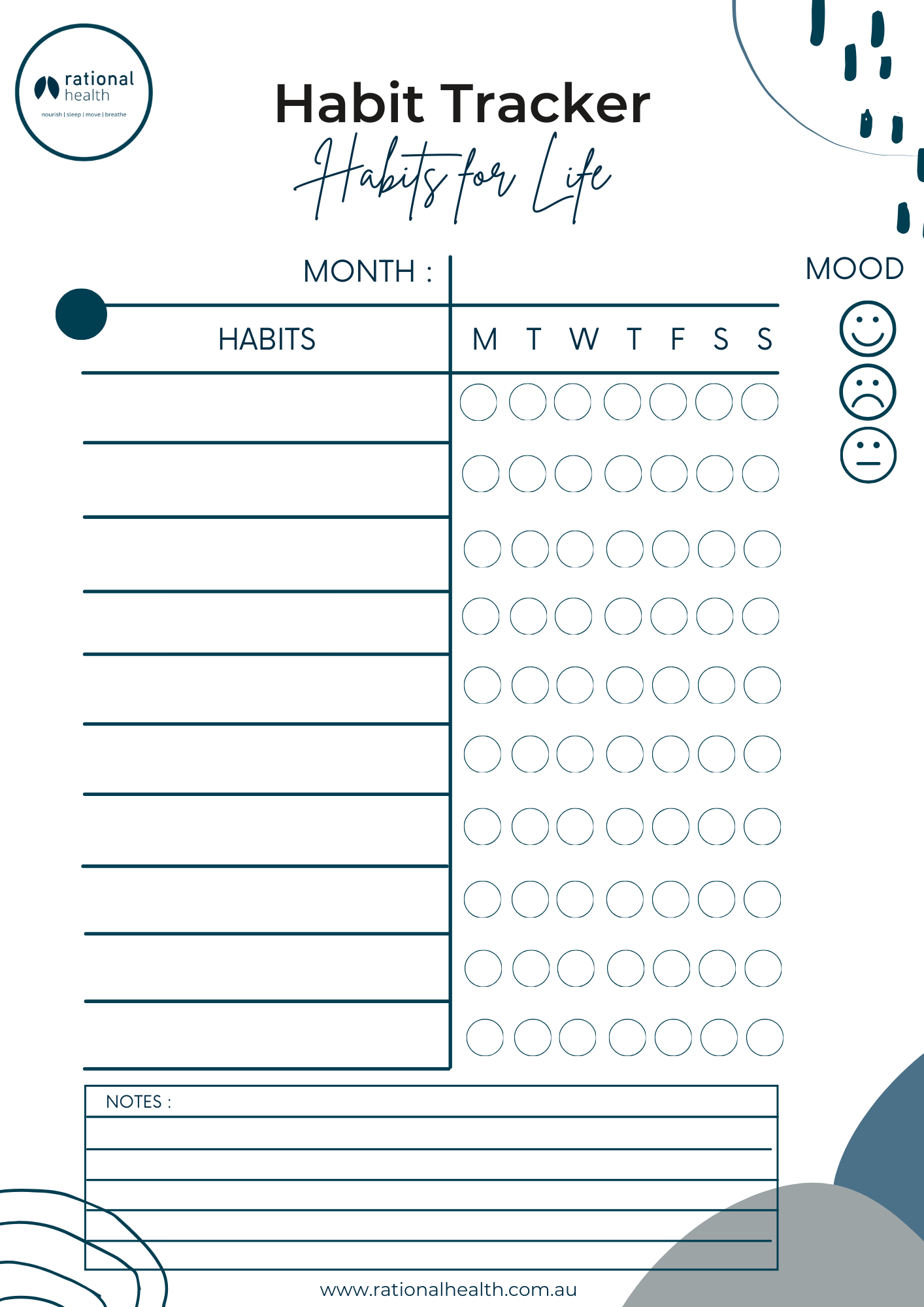
Choose no more than 3 tiny new habits that you would like to implement. Do them consistently for at least 3 months (????). Until it seems effortless, without any cognitive load. When you are ready, try adding another 2 or 3. I have made a single page Habit Track Sheet that you could print to help you stay on track. You can find it here link.
Change your identity.
This sounds a bit extreme, yet this is what many successful weight loss maintainers reported in a longitudinal interview study conducted by Kwasnicka et al. (2019)6. Participants in the study referred to an identity shift. Where they previously perceived themselves to being a constant dieter, they now accept a new way of life involving awareness of their weight and behaviour.
Some suggestions
The list is not prescriptive. Only you know what will be easiest to start with or where the biggest bang for your buck will be.
Drink a glass of water first thing in the morning.
Only have one cup of milky coffee.
Eat +20g of protein at every meal.
Eat smaller portions
Have a healthy snack ready for when you come home from work (apple?).
Swap you double-choc-chip cookie (250 cal) for a lower calorie Marie biscuit (36 cal).
Book and pay for exercise in advance.
Put out exercise clothes the night before.
Weigh regularly.
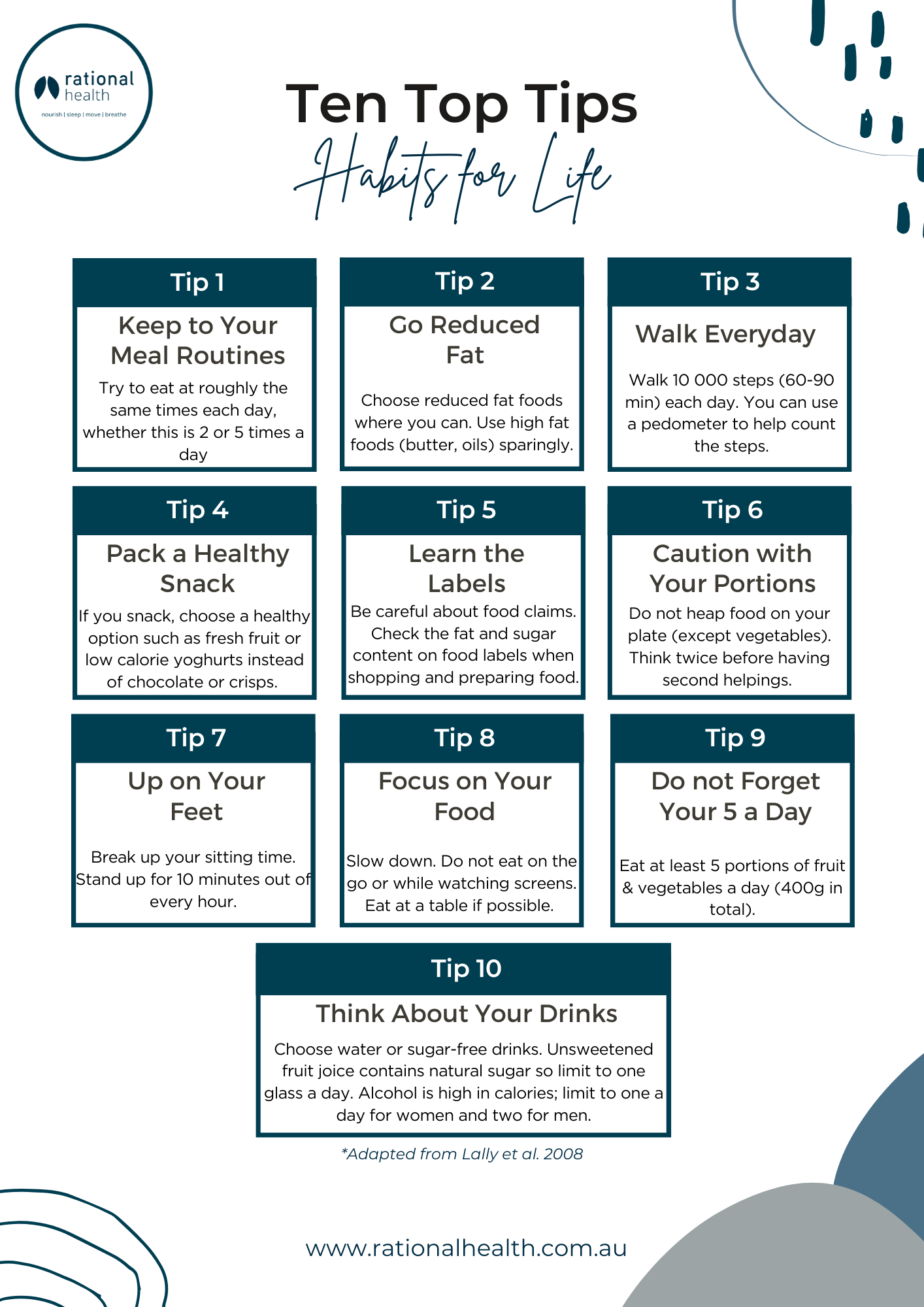
Lally et al. (2008) conducted a randomised controlled trial where participants were give a leaflet containing advice on habit formation and simple recommendations. Together with the Top Ten Tips leaflet they also received with a self-monitoring checklist. In as little as 8 weeks, participants who received the leaflet lost significantly more weight than those in the waiting-list control group. They continued to lose weight at 32 weeks.
What can you take away from this? Awareness of simple guidelines, help to implement tiny habits and self-monitoring can be sufficient in weight management.
I have adapted the Top Ten Tips leaflet for you to download here.
Failing
Yes, you may “fail”. Everyone does. Nobody eats healthy 100% of the time. If there were no negative consequences I would prefer to have cake for breakfast, every day. One day “off-the-rails” does not make a lifetime. Every tiny step helps. Every time you ‘practice’ the desired behaviour/ action, you reinforce the habit formation. The more you do it, the easier it becomes.
These changes might seem insignificant. The compounding effect on your ability to maintain your weight is tremendous.
You can do hard things
Do what is easy to start with. Ensure tiny successes with tiny habits.
Healthy people do healthy things.
Most of the time.
You can be a healthy person.
About Estelle
Estelle’s early career was in financial modelling and reporting in the mining industry. Estelle’s growing interest in health and medical science led to a change direction and she completed a Bachelor of Biomedical Science at the University of Newcastle in 2017. To use this knowledge in a more practical and client focus way, she completed her Bachelor of Health Science Nutrition & Dietetic Medicine in 2020. She is also a qualified breath coach. These formal qualifications inform her philosophy about health, nutrition, breathing and influence her clinical focus.
Hall KD, Kahan S. Maintenance of Lost Weight and Long-Term Management of Obesity. Med Clin North Am. 2018 Jan;102(1):183-197. doi: 10.1016/j.mcna.2017.08.012. PMID: 29156185; PMCID: PMC5764193.
Cleo G, Isenring E, Thomas R, Glasziou P. Could habits hold the key to weight loss maintenance? A narrative review. J Hum Nutr Diet. 2017 Oct;30(5):655-664. doi: 10.1111/jhn.12456. Epub 2017 Feb 2. PMID: 28150402.
Neal DT, Wood W, Labrecque JS et al 2012. How do habits guide behaviour? Perceived and actual triggers of habits in daily life. J Exp Soc Psychol 48, 492-498
Gardner B, Richards R, Lally P, Rebar A, Thwaite T, Beeken RJ. Breaking habits or breaking habitual behaviours? Old habits as a neglected factor in weight loss maintenance. Appetite. 2021 Jul 1;162:105183. doi: 10.1016/j.appet.2021.105183. Epub 2021 Feb 27. PMID: 33651994.
Gorin AA, Leahey TM, Cornelius T, Bourgea K, Powers TA. Self-control and grit: associations with weight management and healthy habits. J Behav Med. 2024 Feb;47(1):160-167. doi: 10.1007/s10865-023-00431-9. Epub 2023 Jul 13. PMID: 37440156.
Kwasnicka D, Dombrowski SU, White M, Sniehotta FF. 'It's not a diet, it's a lifestyle': a longitudinal, data-prompted interview study of weight loss maintenance. Psychol Health. 2019 Aug;34(8):963-982. doi: 10.1080/08870446.2019.1579913. Epub 2019 Mar 23. PMID: 30905184.