

This post is for information and education purposes only, it is not medical advise.
“Your labs show you have kidney disease”
This was the message a healthy, very fit, 30-something, Crossfit athlete received from her doctor after a routine blood test. This is really scary.
She is not alone in this experience. This happens frequently, especially in the athletic population. It is a little bit frustrating, because a tiny bit of education for can save a lot of angst - for doctors and patients.
Kidney disease can go unnoticed for many years. And kidney disease can be irreversible. Symptoms often only show up when kidney function is down to ~30%1. (How amazing are your kidneys that it can work with only 30% capacity!)
Creatine increase a blood biomarker called eGFR that is used to identify poor kidney function. This does NOT mean that taking creatine is harmful to a healthy kidney.
Many athletes take supplements to help them perform and recover better. Creatine, as creatine monohydrate (CrM), is one of the safest and most widely used supplements for athletic performance23.

An international team of creatine research experts reviewed published research in 2021 and 2024 to dispel misconceptions involving CrM. They confirmed that CrM safety data is extremely high and it has few side-effects4. The most frequently reported side-effect is that it increase the water content of skeletal muscles and for some people this increase the body weight by ~0.5-1.0kg.
I personally take ~5g of creatine monohydrate every day. Mostly because I quite like my brain cells :)
To avoid confusion between creatine and creatinine, I will use Cr for creatine and Crn for creatinine.
The Short Answer
Creatine (Cr) is a protein molecule produced mostly in the liver. We also absorb creatine from the animal protein in our diet. The most widely used supplement is in the form creatine monohydrate (CrM).
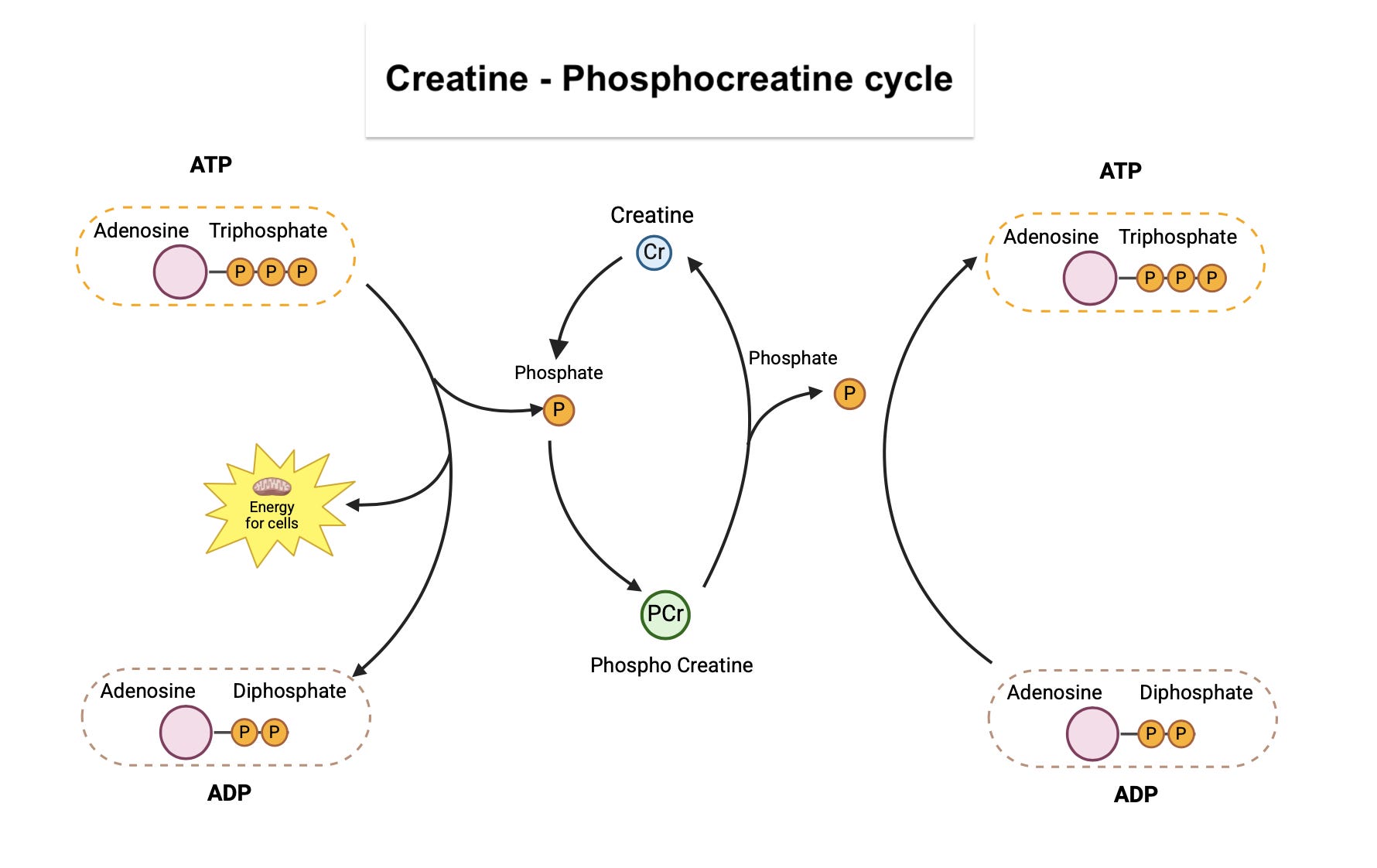
Creatine is exported from the liver and stored in muscle tissue where it combines with a phosphate (P) molecule to form phosphocreatine, PCr (sometime referred to as or creatine-phosphate). PCr is used an energy buffer by donating the phosphate to ADP to quickly reform ATP.
Around 2% of creatine (Cr) and phosphocreatine (PCr) is daily degraded into a waste molecule called creatinine (Crn). The amount of Crn is produced at a constant rate, depending on the muscle mass of the person. More muscle - more Crn - AND more Cr-PCr in the muscle - more Crn.
Creatinine (Crn) is exported from cells into the blood stream and eventually finds it way into the kidneys. The kidneys metabolise (eliminate) almost all Crn.
The Crn content of blood is used to estimate the kidney filtration function, called estimated Glomerular Filtration Rate (eGFR).
When there is a higher than expected (calculated) level of Crn in the blood it indicates that the kidney filtration system is not working properly.
Creatine (Cr) supplementation increases the creatine content of muscle cells. At a constant rate of degradation of 2%, there will be higher levels of the waste product creatinine (Crn) in the blood compared to a no supplementation.
On a routine blood test, Crn is therefore higher than expected and it falsely indicates that the kidney filtration is not working properly.
Ask your doctor to use Cystatin C as an alternative test to assess kidney function which is not affected by muscle mass, diet or supplementation.
How does Creatine Supplementation affect your Labs?
Muscle tissue store and use creatine (Cr) and phosphocreatine (PCr). Approximately 2% is degraded daily into creatinine (Crn) and exported to the blood. The kidneys excrete creatinine (Crn) into urine. The total quantity in grams of creatinine found in the blood can therefore be predicted.
The total creatine (Cr) content is higher in people with more muscle mass. It also goes up when eating a higher protein diet and with creatine (CrM) supplementation.
Supplementing with creatine increase its use and also the metabolites. You make more creatinine (Crn) than you would if you were not supplementing.
On routine blood tests, creatinine (Crn) levels are used to calculate the ability of kidneys to filter out protein molecules from the blood. Higher levels of creatinine (Crn) indicates that the calculated glomerular filtration rate (eGFR) is too low.
If your kidneys are not working properly - not excreting waste and excess products effectively, these products will stay in the blood stream.
Supplementing with creatine (Cr) increase creatinine (Crn) levels in the blood. In the case of creatine (CrM) supplementation, creatinine (Crn) levels go up but BUN is normal. Kidney function is most likely normal.
Creatinine (Crn) levels will go back to normal levels when supplementation with creatine (Cr) is stopped for at least two weeks. However, most athletes will not be willing to do this.
Instead of stopping supplementation before a blood test, ask your doctor to use the cystatin C test to evaluate kidney function when you are supplementing with creatine (Cr). Cystatin C levels are not affected by muscle mass, higher protein dietary intake or creatine supplementation.
How does Creatine work?
In humans, creatine is synthesised primarily in the liver from the amino acids, glycine, arginine and methionine5. From the liver it is exported to cells with a high energy demand, muscle, brain, heart and retina. Inside these cells, creatine (Cr) combine with a phosphate molecule to form phosphocreatine (PCr) and serves as a short-term energy store (see figure 1 below).
Creatine is an energy substrate for cells that use a lot of energy. Our cells make creatine in many cell types - typically muscle but brain cells too.
Adenosine triphosphate (ATP) is the energy currency of cells. The three phosphates are tightly bound to the adenosine. “Breaking” the phosphate from the ATP molecule, release usable energy. Imagine you have something glued together. When you pull really hard to seperate them you can hear a snapping sound. The sound is the energy being released from the glued bond.
When ATP (tri=3 phosphates) loses a phosphate it becomes ADP (di=2 phosphates) and then later AMP (mono=1 phosphate). By increasing the resting phosphocreatine levels, ATP can be quickly generated.
Basically, creatine picks up the free phosphate released from ATP, holds it in storage to be released on demand to reforms ATP with the help of the enzyme creatine kinase. A large pool of PCr is available for immediate regeneration of ATP in the cytosol and mitochondria.
Supplementing with creatine increase the amount of creatine and phosphocreatine in cells. Muscle (and brain) cells needs a lot of ATP energy. Short intense activities rely on the PCr pool to quickly replenish ATP.
“It is only for body builders and gym bro’s” - not so fast…
Creatine supplementation became popular after the 1992 Olympic Games with Linford Christie (100m gold) and Sally Gunnell (400m hurdle gold) both stating they were using it. Over 80% of athletes were using it by the next Olympics.
Creatine monohydrate is one of the most studied sports enhancing supplements and have excellent safety data6.
A typical dose is 3-5g per day as creatine monohydrate. It does not matter what time of the day you are taking7. The benefit is derived from saturating the cells and maintaining the levels of phosphocreatine.
Creatine Monohydrate supplementation has shown benefits for:
Increasing muscle mass during resistance training 8
Older adults in exercise 9
Lower markers of oxidative stress and the inflammatory process 10
Safe in teens11
Sleep deprivation 12
Depression 15
Cognitive Function16
Women and bone health when combined with resistance exercise (mixed evidence) 19
Initial data show benefits and safety in pregnancy 2021
Kidney Function Tests
Your kidneys are mini water purification plants that process about 180 litres of blood per day. They selectively return some substances to the blood stream and excrete others. This process is called glomerular filtration, tubular reabsorption and tubular excretion (referring to anatomical structures within the kidney). Molecules reclaimed include glucose, amino acids and salt. Waste products, toxins and excess salts are excreted to urine.
If your kidneys work well, there should not be any sugar or protein molecules in the urine.
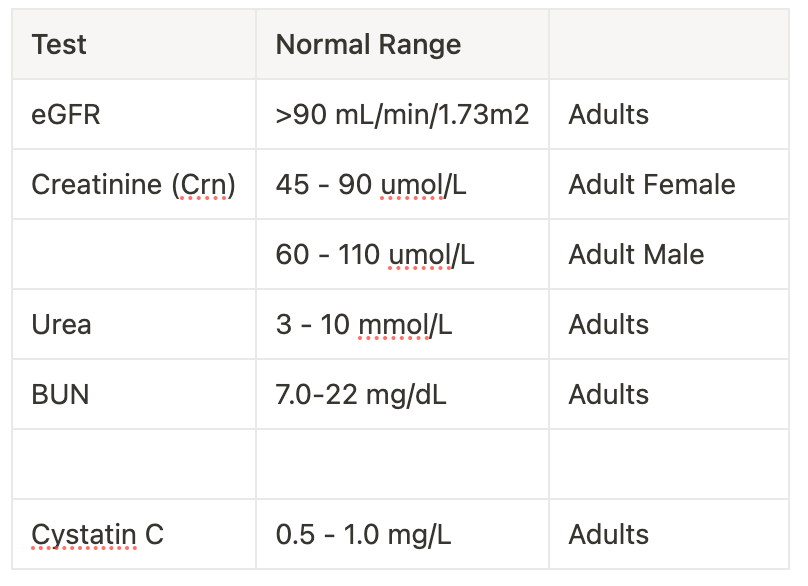
Typical kidney function blood tests include eGFR, Creatinine (Crn) and BUN or urea. Less used is Cystatin C.
Creatinine (Crn)
Creatinine (Crn) is a (waste) metabolite of creatine (Cr) and phosphocreatine (PCr). At a conversation rate of ~1.7%, a 70kg man with ~120g of total Cr content, will produce 2g/day of creatinine (Crn) 22. Creatinine (Crn) constantly diffuses out of cells to be excreted by the kidneys in the urine.
Based on the ~2% daily metabolising rate of Cr and PCr, the total quantity of creatinine (Crn) detectable in the blood can be calculated. Too high levels, indicate that the kidneys are not able to filter and dispose of it.
Creatinine (Crn) levels are influenced by muscle mass, gender, age, dietary protein, creatine supplementation and certain disease states.
eGFR
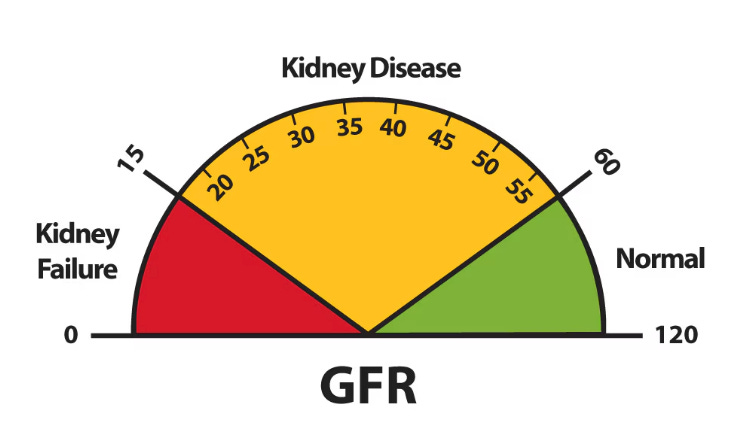
The rate at which your kidneys form filtrate is called the glomerular filtration rate (GFR). The eGFR (estimated) is a measure of the function of your kidneys. Low levels of eGFR indicate kidney disease.
The eGFR calculation is based on predicted creatinine (Crn) levels in the blood.
Higher levels of blood creatinine (Crn) leads to a lower eGFR and can indicate that your kidneys are not able to degrade Crn efficiently.
BUN or Urea
Urea is a nitrogen-containing waste product of protein metabolism. It is released by the liver into the blood to be filtered by the kidneys and excreted in urine. Healthy kidneys eliminate >90% of urea produced daily.
BUN stands for Blood Urea Nitrogen and is only the nitrogen part of urea molecules.
High Urea and BUN values in the blood suggest impaired glomerular filtration and kidney function.
Urea levels are raised by age, higher protein diets and renal disease. Low levels are seen with pregnancy, low protein diets, water-retention and liver-disease.
Cystatin C (CysC)
Cystatin C is a small protein remnant that is produced by most cells. (For the nerds, is is the product of a “housekeeping” gene expressed in all nucleated cells and is produced at a constant rate.) Similar to other protein molecules, the kidneys reabsorb Cystatin C from the filtrate and is completely metabolised. You should not have any Cystatin C in your urine.
If you do have too high levels of Cystatin C in your blood, then it could mean that there is a problem with the kidney filtration system.
Cystatin C can be used as an alternative test to creatinine (Crn) and creatinine clearance to screen for kidney dysfunction. Levels are not affected by diet or creatine (CrM) supplementation.
Cystatin C is considered to have a better correlation to GFR than serum creatinine (Crn)23.
About Estelle
Estelle’s early career was in financial modelling and reporting in the mining industry. Estelle’s growing interest in health and medical science led to a change direction and she completed a Bachelor of Biomedical Science at the University of Newcastle in 2017. To use this knowledge in a more practical and client focus way, she completed her Bachelor of Health Science Nutrition & Dietetic Medicine in 2020. She is also a qualified breath coach. These formal qualifications inform her philosophy about health, nutrition, breathing and influence her clinical focus.
Reference:
Vaidya SR, Aeddula NR. Chronic Kidney Disease. [Updated 2024 Jul 31]. In: StatPearls [Internet]. Treasure Island (FL): StatPearls Publishing; 2025 Jan-. Available from: https://www.ncbi.nlm.nih.gov/books/NBK535404/
Kreider RB, Jäger R, Purpura M. Bioavailability, Efficacy, Safety, and Regulatory Status of Creatine and Related Compounds: A Critical Review. Nutrients. 2022 Feb 28;14(5):1035. doi: 10.3390/nu14051035. PMID: 35268011; PMCID: PMC8912867.
Balestrino M. Role of Creatine in the Heart: Health and Disease. Nutrients. 2021 Apr 7;13(4):1215. doi: 10.3390/nu13041215. PMID: 33917009; PMCID: PMC8067763.
Antonio J, Brown AF, Candow DG, Chilibeck PD, Ellery SJ, Forbes SC, Gualano B, Jagim AR, Kerksick C, Kreider RB, Ostojic SM, Rawson ES, Roberts MD, Roschel H, Smith-Ryan AE, Stout JR, Tarnopolsky MA, VanDusseldorp TA, Willoughby DS, Ziegenfuss TN. Part II. Common questions and misconceptions about creatine supplementation: what does the scientific evidence really show? J Int Soc Sports Nutr. 2025 Dec;22(1):2441760. doi: 10.1080/15502783.2024.2441760. Epub 2024 Dec 25. PMID: 39720835; PMCID: PMC11703406.
Taegtmeyer H, Ingwall JS. Creatine--a dispensable metabolite? Circ Res. 2013 Mar 15;112(6):878-80. doi: 10.1161/CIRCRESAHA.113.300974. PMID: 23493302; PMCID: PMC3646410.
Antonio J, Brown AF, Candow DG, Chilibeck PD, Ellery SJ, Forbes SC, Gualano B, Jagim AR, Kerksick C, Kreider RB, Ostojic SM, Rawson ES, Roberts MD, Roschel H, Smith-Ryan AE, Stout JR, Tarnopolsky MA, VanDusseldorp TA, Willoughby DS, Ziegenfuss TN. Part II. Common questions and misconceptions about creatine supplementation: what does the scientific evidence really show? J Int Soc Sports Nutr. 2025 Dec;22(1):2441760. doi: 10.1080/15502783.2024.2441760. Epub 2024 Dec 25. PMID: 39720835; PMCID: PMC11703406.
Candow DG, Forbes SC, Roberts MD, et al. Creatine O’Clock: does timing of ingestion really influence muscle mass and performance? Front sport act living [Internet]. 2022. [cited 2022 Dec 30];4.
Burke R, Piñero A, Coleman M, et al. The effects of creatine supplementation combined with resistance training on regional measures of muscle hypertrophy: a systematic review with meta-analysis. Nutrients [Internet]. 2023. [cited 2023 Apr 29];15(9):2116.
Devries HA, Tichy MW, Housh TJ, et al. A method for estimating physical working capacity at the fatigue threshold (PWCFT). Ergonomics [Internet]. 1987. [cited 2024 Jun 13];30(8):1195–1204.
Cordingley DM, Cornish SM, Candow DG. Anti-inflammatory and anti-catabolic effects of creatine supplementation: a brief review. Nutrients [Internet]. 2022. [cited 2022 Dec 8];14(3):544.
Metzger GA, Minneci PM, Gehred A, et al. Creatine supplementation in the pediatric and adolescent athlete– a literature review. J Orthop [Internet]. 2023. [cited 2024 Jun 14];38:73–78.
McMorris T, Harris RC, Swain J, et al. Effect of creatine supplementation and sleep deprivation, with mild exercise, on cognitive and psychomotor performance, mood state, and plasma concentrations of catecholamines and cortisol. Psychopharmacology (Berl) [Internet]. 2006. [cited 2021 Oct 29];185(1):93–103.
Sullivan P, Geiger J, Mattson M, et al. Dietary supplement creatine protects against traumatic brain injury. Ann Neurol [Internet]. 2000. [cited 2021 Oct 25];48(5):723–729.
Sakellaris G, Kotsiou M, Tamiolaki M, et al. Prevention of complications related to traumatic brain injury in children and adolescents with creatine administration: an open label randomized pilot study. J Trauma [Internet]. 2006. [cited 2022 Dec 18];61(2):322–329.
Juneja K, Bhuchakra HP, Sadhukhan S, Mehta I, Niharika A, Thareja S, Nimmakayala T, Sahu S. Creatine Supplementation in Depression: A Review of Mechanisms, Efficacy, Clinical Outcomes, and Future Directions. Cureus. 2024 Oct 16;16(10):e71638. doi: 10.7759/cureus.71638. PMID: 39553021; PMCID: PMC11567172.
Sandkühler, J.F., Kersting, X., Faust, A. et al. The effects of creatine supplementation on cognitive performance—a randomised controlled study. BMC Med 21, 440 (2023). https://doi.org/10.1186/s12916-023-03146-5
Balestrino M. Role of Creatine in the Heart: Health and Disease. Nutrients. 2021 Apr 7;13(4):1215. doi: 10.3390/nu13041215. PMID: 33917009; PMCID: PMC8067763.
Aron A, Landrum EJ, Schneider AD, Via M, Evans L, Rawson ES. Effects of acute creatine supplementation on cardiac and vascular responses in older men; a randomized controlled trial. Clin Nutr ESPEN. 2024 Oct;63:557-563. doi: 10.1016/j.clnesp.2024.07.008. Epub 2024 Jul 22. PMID: 39047868.
Scott C. Forbes, Sergej M. Ostojic, Tacito P. Souza-Junior, Darren G. Candow; A High Dose of Creatine Combined with Resistance Training Appears to Be Required to Augment Indices of Bone Health in Older Adults. Ann Nutr Metab 9 June 2022; 78 (3): 183–186. https://doi.org/10.1159/000520967
Ostojic SM, Stea TH, Ellery SJ, et al. Association between dietary intake of creatine and female reproductive health: evidence from NHANES 2017–2020. Food Sci Nutr [Internet]. 2024. [cited 2024 Jun 14].
Tran NT, Kelly SB, Snow RJ, et al. Assessing creatine supplementation for neuroprotection against perinatal hypoxic-ischaemic encephalopathy: a systematic review of perinatal and adult pre-clinical studies. Cells [Internet]. 2021. [cited 2024 Jun 14];10(11):2902.
Wyss M, Kaddurah-Daouk R. Creatine and creatinine metabolism. Physiol Rev. 2000 Jul;80(3):1107-213. doi: 10.1152/physrev.2000.80.3.1107. PMID: 10893433.
Laterza OF, Price CP, Scott MG. Cystatin C: an improved estimator of glomerular filtration rate? Clin Chem. 2002 May;48(5):699-707. PMID: 11978596.