
Friday Tidbits #12: Stress and Chronic Sighing
Welcome to Friday Tidbits. This is a very short email with morsels of information to help you tweak your life and health for optimum longevity and healthy ageing.

Chronic sighing tells me a lot about your stress
We all sigh many times during the day. Sighing is healthy and forms an important part of normal breathing.
But like so many things in biology, too much of a good thing is not good. If you are sighing every 30 seconds, it is not a good thing. And you are most likely annoying those around you. In the extreme, there is something called a sigh syndrome, characterised by irrepressible persistence of sighing1. A large percentage of these patients have a history of traumatic experience or anxiety.
A sigh is loosely defined a deeper, bigger than normal inhale, followed by a longer exhale and then a pause called a post-sigh apnea. Normal breathing should resume after the pause.

Biology
We need to inhale oxygen to help make energy for living and performing. CO2 builds up in your blood as a byproduct of making cellular energy (ATP) - even sitting quietly and reading this newsletter, your cells are making and using energy. We exhale the excess CO2. When you hold your breath, CO2 build up, a sense of air hunger is felt and is translated as an urge to breathe.
O2 + glucose/ fatty acids -> ATP + CO2 + H2O
Every person has a normal operating range of CO2 - a minimum and maximum concentration in the blood where we experience no physiological or psychological stress. For this discussion, the actual numbers do not matter. When the concentration of CO2 in the blood reaches the upper limit, the brain signals the respiratory muscles to work - mainly to initiate an exhale to get rid of the excess CO2.
From a physiological perspective the sigh allows the release of a build up of CO2 via the longer exhale. This will restore CO2 levels to its operating range.
With chronic stress, breathing mechanics can change. For some people, it leads to faster, smaller, shallower inhales and insufficient exhales. In other words, the exhales are not big enough to restore the CO2 range and it slowly build up. as an analogy, imagine you are pouring 500ml cups of water in a bucket and only taking out 300ml cups. Over time the bucket will fill. To restore homeostasis (balance), you will need to dump a lot of water out at once - a big sigh.
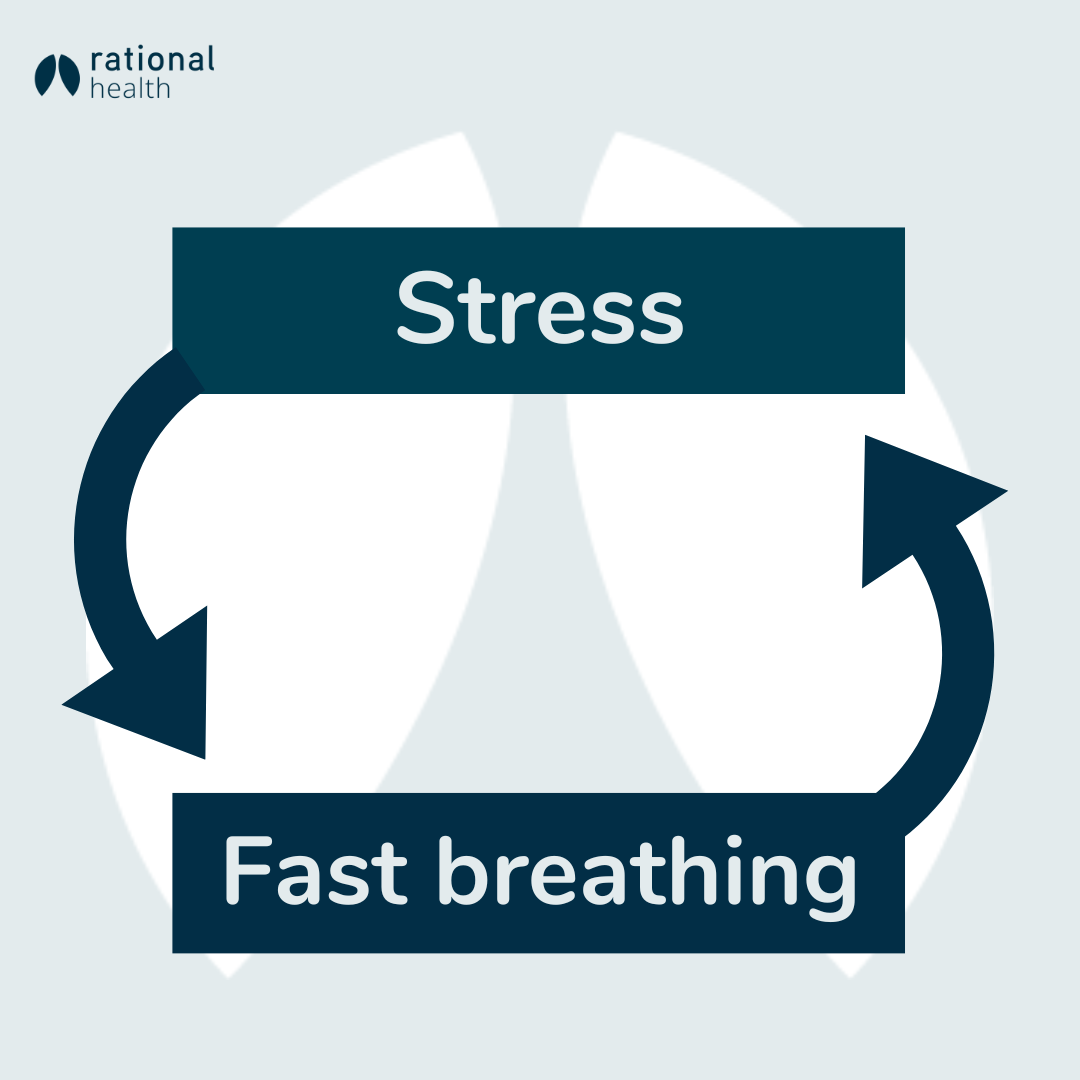
The bigger than normal inhale of a sigh, restores the maximal expansion of the lungs to prevent progressive collapse of alveoli (Ramirez 2014). Sighing also restores breathing variability. Almost like rebooting your computer. More on this in a future post or read the excellent paper by Jan-Marino Ramirez.
Psychology
Sighing is also a way for us to change our psychological state. It signals the end of one state and the transition to the next state - often from a state of high stress or high sympathetic activation to a relaxed state or more parasympathetic. There is a strong relationship between sighs and deep emotion2.
Normal sighing occurs:
after we cry - to signal the end of crying
when we are grieving, to shift into a calmer state (though still sad) 3
after a big scare, to signal relief and relaxation
at the end of a laugh,
when we are in love
as we fall asleep
before waking
Excessive sighing during periods of chronic stress, is a way for the our brains to attempt to shift out of high sympathetic, stressed state to one of more calm and relaxed.
What can you do?
Our breath sits at the intersection of our body and brain - it is a two-way connection. When we feel stressed or anxious it changes the way we breathe - typically faster and shallower.
But breathing can change how we feel.
Try to breathe hard and fast for 1 minute and notice the warmth and increased alertness. Breathe hard and fast for 5 minutes and you are very likely to feel dizzy, disoriented and not able to concentrate. Breathing slower has been recommended to reduce stress and increase relaxation for as long as humans have been around.
Step 1 is breath awareness. Set a timer for 60 minutes and notice your breathing. Is it nasal? Is it fast? Do you feel tightness in your chest?
Step 2, breathe slower. Not all the time, take a few minutes and practice few slower breaths many times during the day. It doesn’t matter how slow. If it feels slow for you, then it is enough. As a general guide start with an even cadence of 4 seconds in and 4 seconds out. If that feels comfortable extend the exhale to 6 seconds. Even as few as 6 breaths can change your state.
Ceramides
I finally found a moisturiser that works and doesn’t leave my hands sticky! My nails also appear to be less dry and flaky - this has been a long-term problem for me. I have only tried the CeraVe Moisturising Lotion. CeraVe have a range of products including facial serums, cleansers, foot creams and baby products. CeraVe products are available at your chemist or on-line.
Many hand creams and body lotions leave a sticky or oily residue that does not absorb. For me it feels like it creates a plastic-like covering over my skin. The fat molecules in most creams and lotions are too big to be absorbed into the skin and remains on top of the skin.
Ceramides are a type of lipid (fat), and there are a few different molecular structures. It is a major part of the structure in the space between skin cells - think of it as the mortar between bricks. Other components that make up the “mortar” are free fatty acids and cholesterol. Ceramides have an essential role in the structure and water barrier function of the skin4. The ceramide content of our skin declines as we age.
High quality skin products use delivery methods such as vesicular systems, micro-emulsions and nanoparticles to increase the absorption and penetration5.
People with conditions like psoriasis, contact or atopic dermatitis have diminished skin barrier function6. They may find products with ceramides more effective compared to those without.
Let me know if you have tried it and if it worked for you!
Sody AN, Kiderman A, Biton A, Furst A. Sigh syndrome: is it a sign of trouble? J Fam Pract. 2008 Jan;57(1):E1-5. PMID: 18171560.
Ramirez JM. The integrative role of the sigh in psychology, physiology, pathology, and neurobiology. Prog Brain Res. 2014;209:91-129. doi: 10.1016/B978-0-444-63274-6.00006-0. PMID: 24746045; PMCID: PMC4427060.
Institute of Medicine (US) Committee for the Study of Health Consequences of the Stress of Bereavement; Osterweis M, Solomon F, Green M, editors. Bereavement: Reactions, Consequences, and Care. Washington (DC): National Academies Press (US); 1984. CHAPTER 6, Toward a Biology of Grieving. Available from: https://www.ncbi.nlm.nih.gov/books/NBK217841/
Coderch L, López O, de la Maza A, Parra JL. Ceramides and skin function. Am J Clin Dermatol. 2003;4(2):107-29. doi: 10.2165/00128071-200304020-00004. PMID: 12553851.
Kahraman E, Kaykın M, Şahin Bektay H, Güngör S. Recent Advances on Topical Application of Ceramides to Restore Barrier Function of Skin. Cosmetics. 2019; 6(3):52. https://doi.org/10.3390/cosmetics6030052
Choi MJ, Maibach HI. Role of ceramides in barrier function of healthy and diseased skin. Am J Clin Dermatol. 2005;6(4):215-23. doi: 10.2165/00128071-200506040-00002. PMID: 16060709.