
Tidbits #16: Low BMD and Fear of Falling
Welcome to Friday Tidbits. This is a short email with morsels of information to help you tweak your life and health for optimum longevity and healthy ageing. This newsletter is free.

Diagnosis of Osteopenia or Osteoporosis induce Fear of Falling
The diagnosis of osteopenia or osteoporosis can totally mess with your brain and induce a fear of falling in adults. I see this in many of my clients. Despite being physically strong and able, the mental stress of increased risk of fracture in the event of falling, can make many people refrain from their favourite activities like hiking, running, skiing or cycling. Suddenly, everyday activities become a hazard - the wet foot path poses a huge threat.
It is reasonable to assume that this happens to older adults over 70 years. BUT, the clients that I see are often in their mid-50s.
There are many studies that show risk of mortality (dying), exponentially increase after a hip or femur fracture or head injury as a result of a fall. WHO states that falls are the second leading cause of ‘unintentional injury deaths’ worldwide for adults older that 60 years. Males and females are equally affected.
Approximately 30% of older adults fall once a year1!
Using NHANES III data*, a survey of 1295 women, aged 60-65 years, showed that nearly 20% of ‘recurrent fallers’ have a 4-fold increased risk of dying within 10 years compared to non-recurrent fallers2. A longitudinal study of 300 women aged >75 years, showed 42% died within 9 years after a fall related injury3.
In the USA, falls are a leading cause of hopitalisation and disability, accounting for $50 billion in medical cost4. It is sobering to learn that fall-associated mortality has more than doubled from 2000 to 2016. The incidence of falling in mid-life is comparable to that in older adults.
We all fall at any age - children probably most of all. When you fall and end up with only a contusion and bruised ego, your life will continue as normal. The risk comes from breaking a bone. Low bone density increase the risk of fracture.
Bone Mineral Density
Low bone density means that you are more likely to break a bone in the event of an accident.
Osteopenia is the clinical term showing a bone mineral density (BMD) lower than the normal reference range - but not low enough to meet the criteria to be considered osteoporosis. On a DEXA scan osteopenia is indicated with a T-score between -1 to -2.5 while osteoporosis the T-score is less than -2.5. Your T-score compares your BMD to what is expected in a healthy young adult. A normal T-score is more than -15.
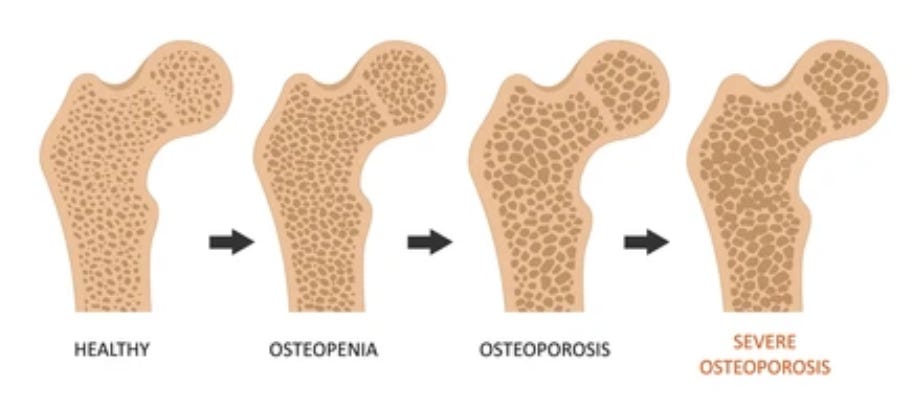
I have covered age related decline of bone density in a previous post, Tidbit #9.
Strength and resistance training
Strength-resistance training, particulary weight-bearing exercise, has been shown to increase bone density.
Increased mechanical loads, from impact and muscles forces, place a strain on bone. Contracting muscles tugs on the bone where they are attached via ligaments. These strains activate mechanosensitive osteocytes (bone cells) which send signals for remodelling - making your bones stronger to cope with the ‘new’ demands of exercise and load6. To build stronger bones, the bones must be subjected to a strain in greater magnitude than what it is used to. In other words, you need to do something that feels harder than most of your day.
There are of course a multitude of strength-resistance exercises. For spine and leg bone density you will focus on lifting heavy things, squatting with or without weight and weight-bearing walking. The latter include carrying a heavy object in one hand (suitcase carry) or both hands (farmers carry).
Fear of Falling
For many people, just getting stronger is not enough to overcome the Fear of Falling. To successfully reduce the Fear of Falling, you need to feel confident in your body's ability to not fall in the first place and to stop you falling when you trip.
The three areas of exercise that specifically increase your ability to reduce fall risk and increase your confidence are:
Type II muscle fibre strength, to allow you to move your leg quickly
Break (stop) muscles, to allow you to stop a movement
Balance, to increase your sensory and proprioception of your body in space and compensate for movement.
Doing strength training will increase your bone health, but it is not enough to overcome the Fear of Falling.
Type 2 muscle Fibre
Broadly speaking our muscles have three types of fibres. Muscles fibres that are slow to fatigue are called Type I and muscles fibres that fatigue quickly and are called Type IIx and IIa. There is actually more nuance, but the sake of simplicity I will stick to the broad classification of Type I and Type II. The classification is based on how fibres contractile speed and use energy substrates.
All muscles have both fibres but some have more of one than the other. Type I fibres are slow contracting speed, use oxidative metabolism and are fatigue-resistant. Slow fatiguing type 1 muscle fibres allows you to walk all day or keep your spine up straight all day, gastrocnemius in the calf and lumbar multifidus in the low back have a large proportion of Type I fibres7.
Type IIx fibers tire quickly but are able to contract really fast and are mostly fuelled through glycolytic metabolism. Type IIa fibers are also able to contract fast and use a combination of oxidative and glycolytic metabolism. These fibre contractions give you explosive power. Sprinters and jumpers have a large proportion of Type II fibres - and train them to stay strong.
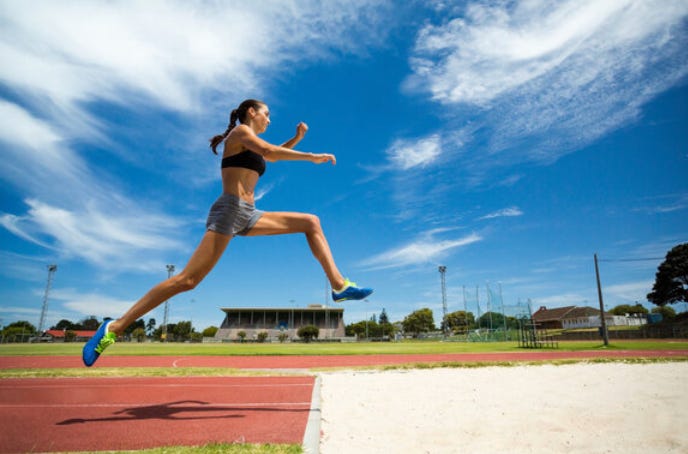
What is important to understand is that in order to move fast your type II fibres need to switch on and contract. The very strong and fast contraction allows for quick movements that can be sustained for a few seconds.
Similar to loss of bone density as we age, we also lose muscle power, strength and mass from the age of 40 years. Age related muscle loss is called sarcopenia. Early this year, a very important research paper by Soendenbroe et.al showed that we lose predominantly Type II fibres as we age8.
As we age we lose our ability to move fast due to the loss in fast-contracting Type II fibres.
The good news is that this does not have to be the case. Soendenbroe et. al showed that this decline is partially reversed through appropriate training.
If you keep training your explosive abilities, you will retain the Type II fibres. This is relevant for combating Fear of Failure: if you are confident in your muscles ability to contract fast you are less likely to fall. When you trip over the cat in the kitchen you want your leg to move forward quickly and stop the fall.
Explosive movements include jumping forward (broad jump), jumping up and sprinting.
Training your ability to stop a fall.
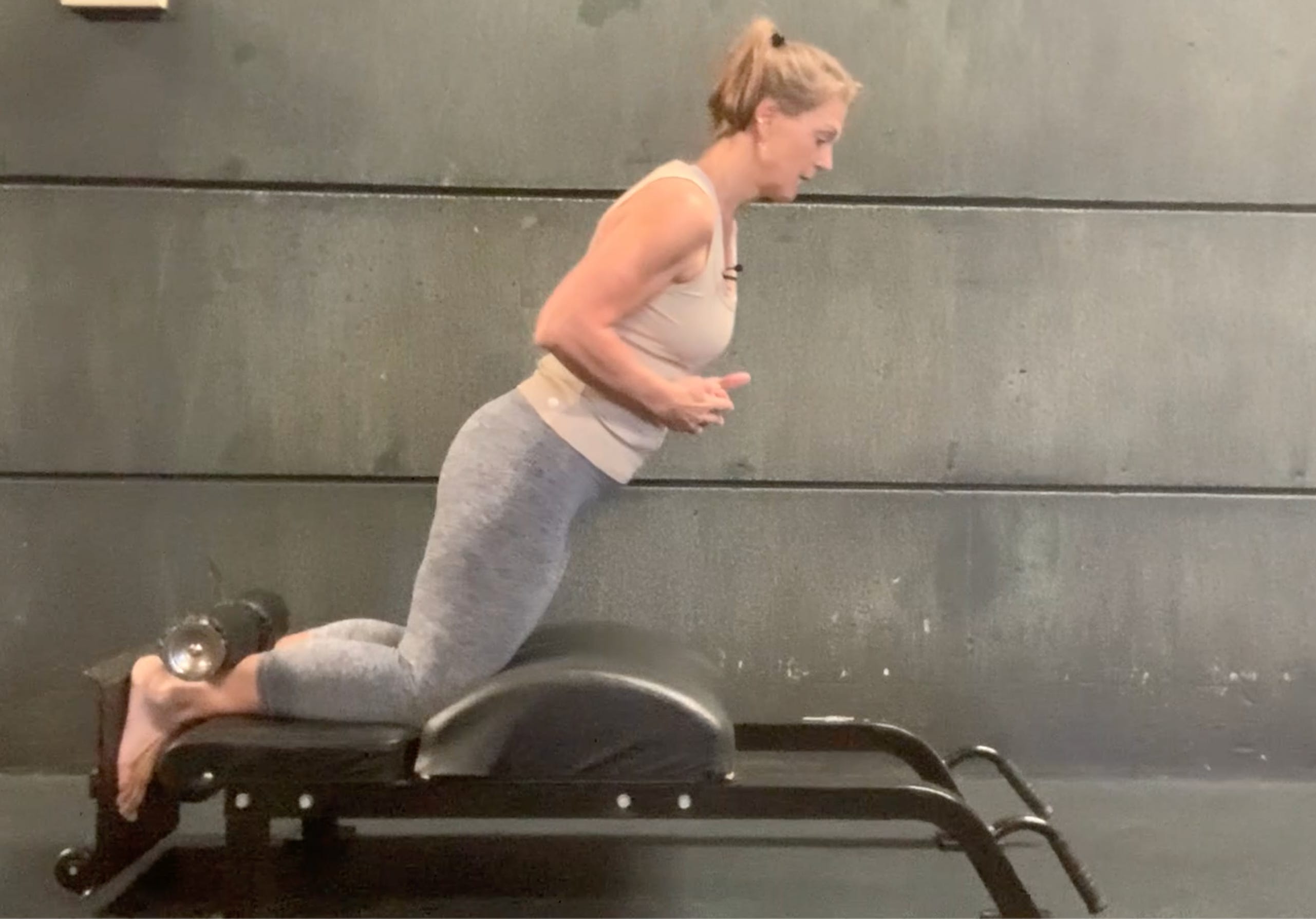
Using the tripping over the cat example above, once your leg has moved forward fast, you now need to stop the forward momentum. Training your “breaks” will stop the forward movement. The main “break” muscles of the legs are your hamstrings. Training hamstring strength through eccentric movements is frequently overlooked in exercise programs.
Training eccentric muscles are associated with more delayed onset muscle soreness (DOMS) compared to concentric muscles (quads). If you are new to eccentric movements, take it slow with fewer reps.
Classic hamstring exercise include Romanian Dead Lift (RDL), Harrop Curls and Nordic Curls.
Balance
So many people tell me their balance is not good. Yet this is the easiest thing to train and takes only a few minutes every day.
Stand on one leg while you brush your teeth or waiting for the kettle to boil. Challenge yourself to walk on a line. The Foot Collective have great tools for training balance and foot strength.
As you gain more confidence, you can balance on a parallette.
Conclusion
Fear of Falling can be debilitation and keep you from living your best life. When you are confident in your body’s ability to move and respond to unpredictable events, you will reduce the Fear of Falling.
I have seen this happen with quite a few of my clients.
Age related muscle decline is preventable. Hope is not a strategy. You have to put the effort in to keep strong and agile as you age.
I have made a video on my Youtube channel where I go through the three areas discussed above with examples of targeted exercise. Remember, there are many ways to skin a cat. The principles remain but the methods can be many. Adjust the exercises according to your expertise and confidence.
*This video is for information purposes only and not intended as medical advice. Please consult a professional before implementing new exercises or practices.
Apologies for the video quality. Apologies for the quality. I was rushed for time. Ever a learning process.
Train today, so that you can move well and with confidence as you get older.
* NHANES: National Health and Nutrition Examination Survey in USA to monitor the health status of population. Participants are followed for many years allowing for longitudinal data analysis
References:
O’Loughlin, Robitaille, Boivin, & Suissa, 1993; Tinetti, Speechley, & Ginter, 1988
Karvonen-Gutierrez, C. A., Ylitalo, K. R., & Peng, M. Q. (2020). Midlife falls are associated with increased risk of mortality in women: Findings from the National Health and Nutrition Examination Survey III. Archives of Gerontology and Geriatrics, 91, 104206. https://doi.org/https://doi.org/10.1016/j.archger.2020.104206
Sylliaas H, Idland G, Sandvik L, Forsen L, Bergland A. Does mortality of the aged increase with the number of falls? Results from a nine-year follow-up study. Eur J Epidemiol. 2009;24(7):351-5. doi: 10.1007/s10654-009-9348-5. Epub 2009 May 19. PMID: 19452127.
Florence CS, Bergen G, Atherly A, Burns E, Stevens J, Drake C. Medical Costs of Fatal and Nonfatal Falls in Older Adults. J Am Geriatr Soc. 2018 Apr;66(4):693-698. doi: 10.1111/jgs.15304. Epub 2018 Mar 7. PMID: 29512120; PMCID: PMC6089380
Varacallo M, Seaman TJ, Jandu JS, et al. Osteopenia. [Updated 2023 Aug 4]. In: StatPearls [Internet]. Treasure Island (FL): StatPearls Publishing; 2024 Jan-. Available from: https://www.ncbi.nlm.nih.gov/books/NBK499878/#
Weaver CM, Gordon CM, Janz KF, Kalkwarf HJ, Lappe JM, Lewis R, O'Karma M, Wallace TC, Zemel BS. The National Osteoporosis Foundation's position statement on peak bone mass development and lifestyle factors: a systematic review and implementation recommendations. Osteoporos Int. 2016 Apr;27(4):1281-1386. doi: 10.1007/s00198-015-3440-3. Epub 2016 Feb 8. Erratum in: Osteoporos Int. 2016 Apr;27(4):1387. PMID: 26856587; PMCID: PMC4791473.
Agten A, Stevens S, Verbrugghe J, Eijnde BO, Timmermans A, Vandenabeele F. The lumbar multifidus is characterised by larger type I muscle fibres compared to the erector spinae. Anat Cell Biol. 2020 Jun 30;53(2):143-150. doi: 10.5115/acb.20.009. PMID: 32647082; PMCID: PMC7343561.
Soendenbroe C, Karlsen A, Svensson RB, Kjaer M, Andersen JL, Mackey AL. Marked irregular myofiber shape is a hallmark of human skeletal muscle ageing and is reversed by heavy resistance training. J Cachexia Sarcopenia Muscle. 2024 Feb;15(1):306-318. doi: 10.1002/jcsm.13405. Epub 2023 Dec 20. PMID: 38123165; PMCID: PMC10834339.
Ahhh… just shows how keen I was to read the next one 😁. Nikki
I didn’t receive #17 Friday tidbits 😟