
Tidbits #18: Dehydration in Cold Weather
Welcome to Friday Tidbits. This is a short email with morsels of information to help you tweak your life and health for optimum longevity and healthy ageing. This newsletter is free every 2 weeks.

Dehydration in Cold Weather
I find it difficult to drink enough fluids when it is really cold. Sure, I drink coffee (1) and tea (multiple), but drinking water takes conscious effort.
My recent hiking experiences in the Rocky Mountains of Canada, left me dehydrated on a few occasions. When your morning urine is very dark, it is a sure sign that you have not had enough fluids the previous day.
Hiking in cold weather it is easy to think you did not sweat much. And making sure the water bottle lasts for the undefined duration, makes you prone to drinking too little during the activity. The cold also makes your nose run, and you end up breathing more through your mouth than you realise.
So how much water do you need to drink during the day?
Fluid Needs
You may have have been told that you need to drink at least 8 glasses of water per day. This has always struck me as non-sensical. How can a 45kg women need the same amount of water as a 100kg man?
Ignoring exercise for a moment, the average adult need 1.5 to 2.5 litres of fluid per day. This is based on ~32ml/kg/d1, equating to 2.2 litres per day for a 70kg person.
Simplified calculation for daily water intake needs: BW kg x 3 x 10= ml/d
for my American friends: BW lb / 2 = oz/d
Our daily fluid intake needs are met through food and liquids. How much liquid depends on what kind of foods you are consuming, physical activity and environmental factors. If you live on dry crackers you will need to increase your fluid intake when compared to fruit and vegetables. Food typically accounts for 500-750ml of fluid. Our body makes 250ml water during many metabolic reactions. The balance of needs to come from water and other beverages, roughly 1500ml2.
On the output side, body fluid loss is classified as sensible and insensible. Sensible losses are obvious, noticeable and can be measured while insensible losses are less noticeable and not easy to measure. The most obvious (sensible) losses of fluid are urine (800-1500ml), stool (100-250ml) and sweat (variable). Insensible fluid loss occurs through unnoticeable evaporation from skin and breathing and can be as much as 600-900ml per day for a healthy adult.
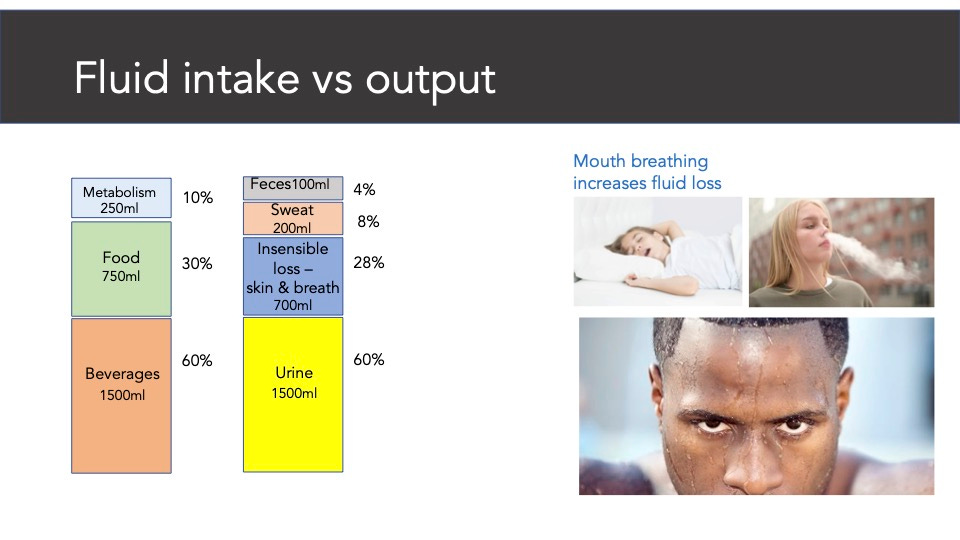
Factors that increase fluid needs:
exercise
hot environment
sauna and hot tubs
mouth breathing
high protein diet
Fluid Balance
Water homeostasis (not too much and not too little) is managed through a complex system in the body. Special osmoreceptors in the brain continually monitor the hydration status. Dehydration reduce blood volume and increase the concentration of solutes in the blood. These changes stimulate the thirst center in the hypothalamus. The hypothalamus is the part of the brain responsible keeping things in balance including hormones, temperature and water balance.
Feelings change behaviour.
In this case, when you feel thirsty, you will be motivated to drink more fluids.
At the same time as blood volume lowers, the hypothalamus-pituitary system release a special messenger called vasopressin or antidiuretic hormone (ADH). ADH tells the kidneys reabsorb more water from the filtrate to decrease urine volume and at the same time increase the concentration.
You will pee less and the colour will be darker.
In a third mechanism, the kidneys release a molecule called renin in response to the lower blood pressure. The renin-angiotensin-aldosterone system (RAAS) increase the absorption of sodium and water by the kidneys from the blood that it filters.
Dehydration consequences
When we sweat a lot, our blood volume decrease and at the same time the concentration (osmolality) of your blood increase. Too low blood volume means that there is not enough blood and pressure for your heart to pump efficiently to all your tissues. Some cells may not get enough oxygen to function optimally.
Effects of mild dehydration:3
feeling thirsty
reduced cognitive performance
reduced exercise performance
fatigue
constipation
reduced capacity to sweat and regulate body temperature
muscle cramps
dry skin
headache
dark & less urination
low blood pressure and dizziness
While the impact on dehydration on sport performance is globally recognised, the effect on brain function is underestimated. Proper hydration is important for optimal cognitive functioning as it plays a vital role in neural conductivity.
Nishi et.al investigated the association between hydration status and cognition in a large prospective cohort study of 1957 adults aged 55-75 years followed over a 2 year period. They found that lower hydration status as measured by serum osmolarity was associated with a greater decline in global cognitive function4.
Clinicians use various tests and markers to evaluate hydration status including urine specific gravity, serum and/or urine osmolality, blood urea nitrogen to creatinine ratio, sodium and potassium levels. There is no gold standard since all these markers mentioned can be influenced by other factors.
At home, the best indicators for dehydration are thirst, urine volume and colour and weight changes.
A 1-2% body water loss can lead to lower sport performance AND cognitive function. Athletes self-monitor their hydration status using the WUT method: weight, urine and thirst.

Colder Climates
It is easy to feel the need for more fluids when the sun is hot and you sweat visibly. In colder climates, our sense of thirst can let us down. It takes more conscious effort to drink water when you feel cold. Any fluid will help: tea, coffee, milk, and soup. Add a slice of lemon to hot water - it will help to warm you up at the same time.
Drinking a glass of water soon after waking, will help to compensate for loss of fluid from our skin and breath during sleep.
If you have not gone to the toilet for a wee at least twice before lunch time, you probably have not had enough to drink.
It does not matter if your fluid intake is plain water or from other beverages. A common myth is that caffeine in coffee and tea will lead to dehydration. This is not true for the average intake. While caffeine as a substance can increase urine output, when you consume it with water - as in the case of coffee or tea - the fluid intake compensate for the tiny diuretic effect.
The following extract is from the National Athletic Trainers Association Position Statement 2017:
“Caffeine does not compromise rehydration or increase urine output when consumed in small quantities (up to 3 mg/kg) during or after exercise. Small amounts of caffeine in a rehydration beverage should not cause harm to the physically active postexercise.” 5
Reference:
Chapter 9. Fluids and Electrolytes. In: Gomella LG, Haist SA. eds. Clinician's Pocket Reference: The Scut Monkey, 11e. The McGraw-Hill Companies; 2007. Accessed June 05, 2024. https://accessmedicine.mhmedical.com/content.aspx?bookid=365§ionid=43074918
Riebl SK, Davy BM. The Hydration Equation: Update on Water Balance and Cognitive Performance. ACSMs Health Fit J. 2013 Nov;17(6):21-28. doi: 10.1249/FIT.0b013e3182a9570f. PMID: 25346594; PMCID: PMC4207053.=
Taylor K, Jones EB. Adult Dehydration. [Updated 2022 Oct 3]. In: StatPearls [Internet]. Treasure Island (FL): StatPearls Publishing; 2024 Jan-. Available from: https://www.ncbi.nlm.nih.gov/books/NBK555956/
Nishi SK, Babio N, Paz-Graniel I, Serra-Majem L, Vioque J, Fitó M, Corella D, Pintó X, Bueno-Cavanillas A, Tur JA, Diez-Ricote L, Martinez JA, Gómez-Martínez C, González-Botella A, Castañer O, Alvarez-Sala A, Montesdeoca-Mendoza C, Fanlo-Maresma M, Cano-Ibáñez N, Bouzas C, Daimiel L, Zulet MÁ, Sievenpiper JL, Rodriguez KL, Vázquez-Ruiz Z, Salas-Salvadó J. Water intake, hydration status and 2-year changes in cognitive performance: a prospective cohort study. BMC Med. 2023 Mar 8;21(1):82. doi: 10.1186/s12916-023-02771-4. PMID: 36882739; PMCID: PMC9993798.
McDermott BP, Anderson SA, Armstrong LE, Casa DJ, Cheuvront SN, Cooper L, Kenney WL, O'Connor FG, Roberts WO. National Athletic Trainers' Association Position Statement: Fluid Replacement for the Physically Active. J Athl Train. 2017 Sep;52(9):877-895. doi: 10.4085/1062-6050-52.9.02. PMID: 28985128; PMCID: PMC5634236.
Hi, very happy to read that drinking tea and coffee can be included in daily fluid amount.