
Tidbits #20: NAC for Sinus Congestion
Welcome to Friday Tidbits. This is a short email with morsels of information to help you tweak your life and health for optimum longevity and healthy ageing. This newsletter is free every 2 weeks.

NAC for Sinus Congestion
On Sunday afternoon I suspected that I might be coming down with a cold. This was not a surprise. Almost everyone I know has recently been sick with some form of the sniffles. A few unlucky ones even had Influenza A. Not fun.
I started my usual regiment of supplements that I rely on. When I do this, most of the time I do not develop a full blown cold. Not this time.
By the time you are really sure that you have a cold, it is too late to prevent it. The best you can do is manage the symptoms. And sleep.

Still there are supplements and nutraceuticals that can help the immune system fight the infection or reduce the side-effects of your immune system. Some of these are herbs, some are vitamins, some are minerals and others are amino acids. I typically will have a combination of these for about a week. Taking a handful of pills twice a day for a week might be overwhelming to some people.
Monday the symptoms were mild runny nose and slight sore throat. Tuesday slightly worse. By Wednesday the congestion in my nose and sinus was more than annoying and the post-nasal drip was making me cough.
It was only Wednesday afternoon that I remembered I have not been taking NAC. Being your own “doctor” is not always a good thing. You risk losing perspective and you do not think through the problem properly.
The stuffy nose symptoms lessened after the 1st dose of oral NAC!
What is NAC and how does it work?
N-Acetylcysteine (NAC), is an amino acid derivative of L-cysteine and the precursor to glutathione. Glutathione is a powerful antioxidant involved in cellular redox balance. Direct supplementation of glutathione and cysteine has not very effective due to the degradation of the former by gastric juices in the stomach and the unstable molecule structure of the latter. NAC is therefore the preferred and effective mechanism to increase intracellular stores of glutathione.
NAC has direct antioxidant and anti-inflammatory effects and is used as a mucolytic1. NAC helps break down mucus in the respiratory tract2.
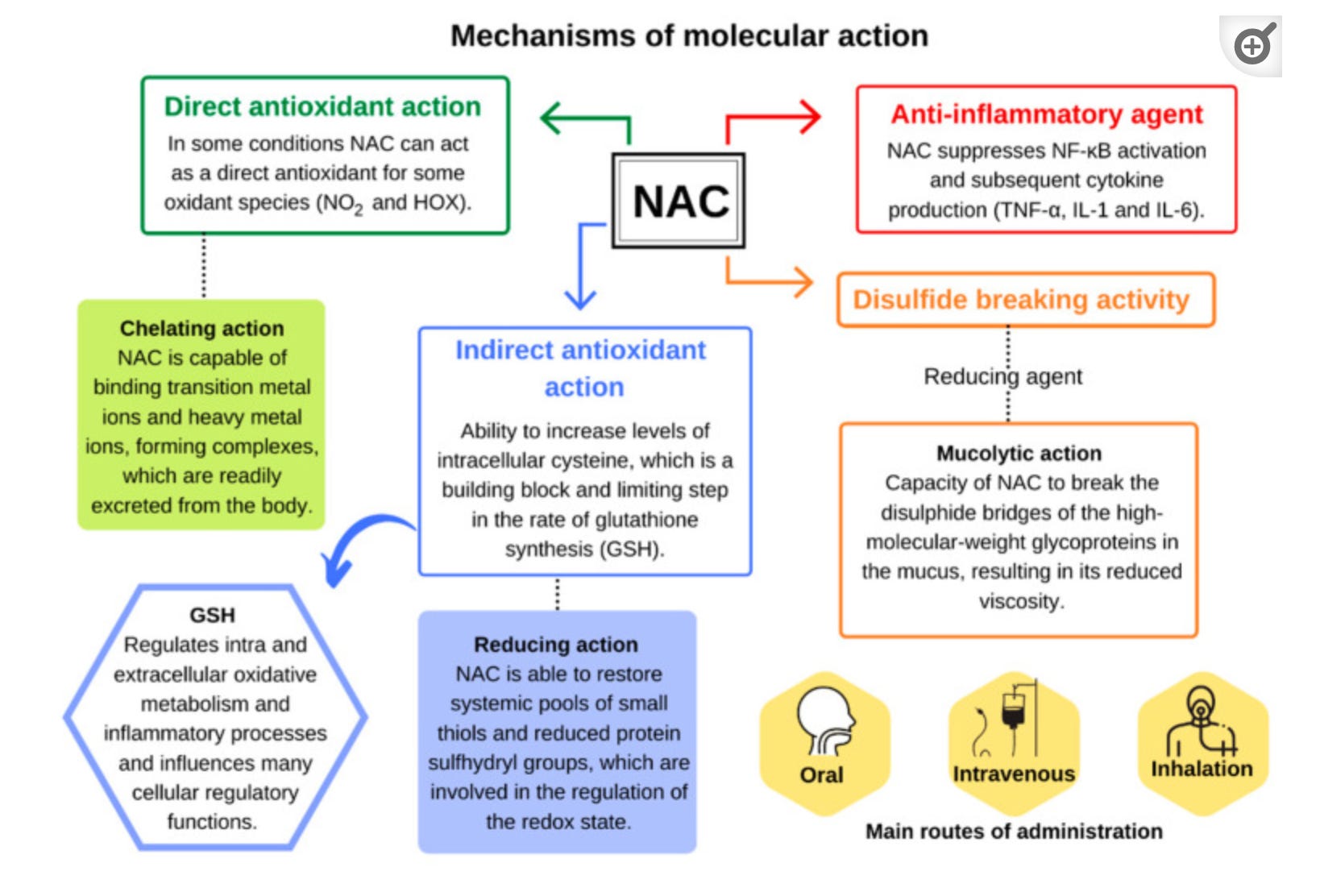
Due to its mucolytic properties, NAC has been used traditionally as a decongestant.
The chemical structure is responsible for it mucolytic activities. There are two functional groups attached to the amino group, a sulfhydral group ( -SH) and an acetyl group ( -COCH3). The sulfur group classify NAC as a biothiol, with the ability to react with reactive oxygen and nitrogen species (ROS and RNS). Thus NAC is a reducing agent - it can reduce free radicals by donating one electron.
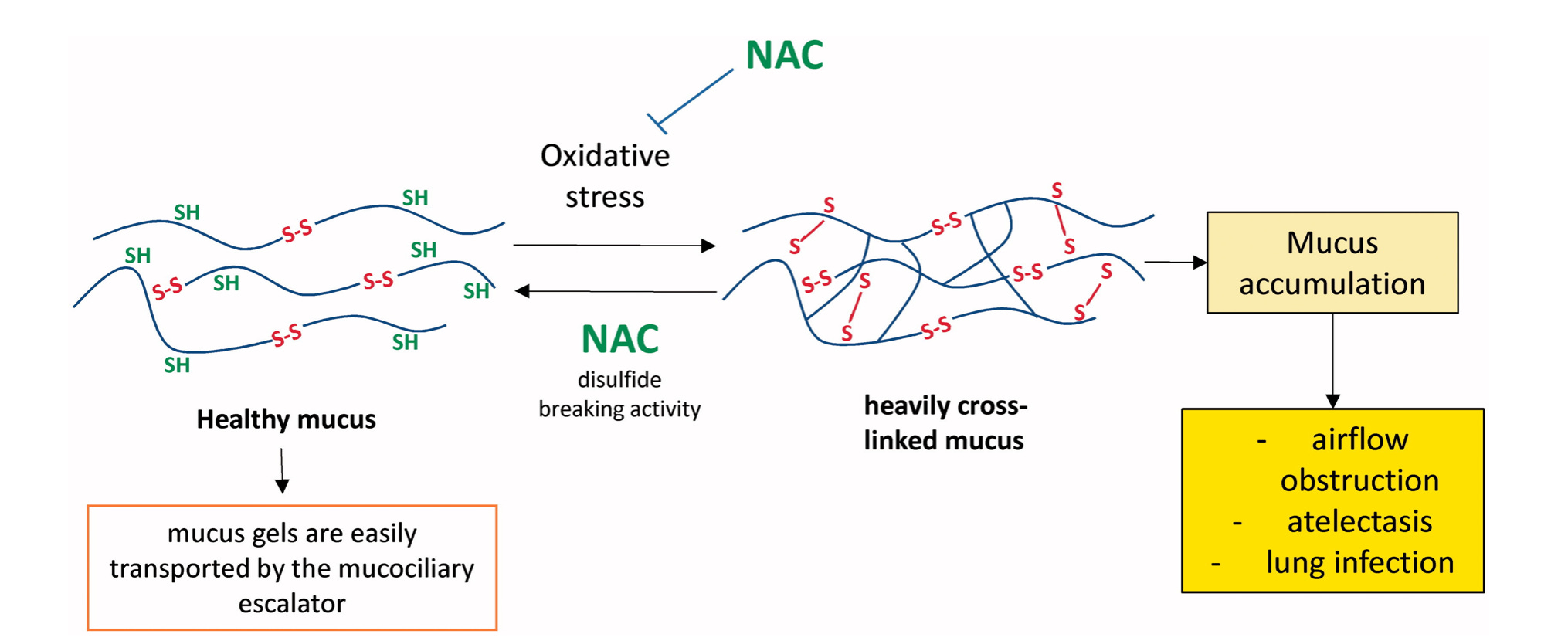
NAC ‘reduce’ the disulfide bonds that hold the mucous proteins together. When the bonds that hold the mucous molecules together are weakened, the mucous becomes less viscous (more fluid) and less sticky3.
In other words, NAC breaks down excessive mucus as experienced with a cold or sinus infection. The mucus is thinner and more fluid. This enables the small hair-like cells (cillia) that move mucus in a wave-like pattern, to move more freely and affective remove and expel mucus. Patients report a less stuffy nose.
Research & Clinical Use
Due to its antioxidant and anti-inflammatory properties, therapeutic uses of NAC covers a wide range of conditions such as 4:
Paracetamol (acetominophen) overdose
Lung diseases (COPD, Cystic Fibrosis, Bronchitis)
Liver diseases (hepatitis)
Gastrointestinal diseases (Crohn’s, Ulcerative Colitis)
Cardiovascular diseases
Psychiatric illnesses
Kidney diseases
Infectious diseases
Cancer
Lung disease research have focused on COPD, cystic fibrosis and chronic bronchitis. Clinical trials show mixed results with dose ranging from 600 to 3000 mg/d. A meta-analysis by Cazzola et.al 5 indicate that low doses may be effective for patients with chronic bronchitis where higher doses might be needed to prevent exacerbations in COPD patients. Clinical research of COPD, cystic fibrosis6 and chronic bronchitis show higher efficacy when the NAC is delivered in an atomised nasal rinse. Unfortunately, I do not of a commercially available NAC nasal spray. A compounding pharmacy may be able to make one.
Though research is lacking, mechanistically the use of NAC should work in all conditions where thick, sticky mucus is produced in excess. Many complementary health practitioners prescribe NAC for patients with colds, chronic cough, rhinitis, sinus infection and recently COVID-19. There are currently 15 studies registered to investigate the use of NAC in COVID-19 infection.
In treating sinus conditions it can be used in combination with antibiotics and or corticosteroids.
In a hospital setting NAC is used for the treatment of paracetamol (acetaminophen) overdose. In the process of metabolising the ingested paracetamol, the liver produce a toxic intermediate molecule, N-acetyl-p-benzoquinone-imine (NAPQI). Glutathione is required to modify and detoxify NAPQI before it can be excreted. NAC works by replenishing the glutathione stores.
Dose, Safety and Side-effects
NAC can be given orally, intravenously and through inhalation.
NAC is generally considered safe through oral supplementation of doses 600-3000mg/d. There is one report of a toxic overdose where the intravenous concentration was miscalculated for a patient with paracetamol overdose7. Side-effects from oral supplementation are rare and include nausea, vomiting and diarrhea in 18%. These are most likely due to the sulfur content that give an unpleasant rotten-egg odour and sour taste.
For mild congestion the oral dose is typically 600-1800mg per day in divided doses.*
It is available as an over the counter supplement in many countries. In Australia you may need a practitioner to prescribe NAC or get it online.
In the USA, the FDA has recently declared NAC an ‘approved drug’. You may still be able to find it through medical practitioners - I am unsure if you will be able to source it online.
NAC may interact with nitroglycerin and potentially other drugs.
Final words
Oral supplemental NAC has been used for many years to enhance antioxidant capacity and as mucolytic. It is generally well tolerated with few side-effects and those most frequently reported as mild nausea. As with most things, a small percentage of people may have an allergic reaction.
The taste and smell can be off-putting to some people, especially in powder form.
In the case of mild head-colds it is very effective in relieving stuffy nose symptoms. It definitely helps sleeping better. And improved sleep quality will help get healthy faster.
The low dose of 300-600mg three times a day should NOT be taken for more than 1 week without clinical supervision*.
NOTE: the thinner mucous in the nasal passages may make the post-nasal drip worse and increase coughing as a result.
NAC works indiscriminately, all mucous membranes may be affected. This includes the lining of the lungs and gastrointestinal tract. Though some practitioners caution the long-term use of NAC, there is currently no direct evidence harm for the GI tract lining integrity.
This is only a short review of NAC, there is much more.
Hope this helps you feel better if you need it.
*Please consult a professional before starting any supplements.
References:
Tenório MCDS, Graciliano NG, Moura FA, Oliveira ACM, Goulart MOF. N-Acetylcysteine (NAC): Impacts on Human Health. Antioxidants (Basel). 2021 Jun 16;10(6):967. doi: 10.3390/antiox10060967. PMID: 34208683; PMCID: PMC8234027.
Schwalfenberg GK. N-Acetylcysteine: A Review of Clinical Usefulness (an Old Drug with New Tricks). J Nutr Metab. 2021 Jun 9;2021:9949453. doi: 10.1155/2021/9949453. PMID: 34221501; PMCID: PMC8211525.
Aldini G., Altomare A., Baron G., Vistoli G., Carini M., Borsani L., Sergio F. N-Acetylcysteine as an antioxidant and disulphide breaking agent: The reasons why. Free Radic. Res. 2018;52:751–762. doi: 10.1080/10715762.2018.1468564
Samuni Y., Goldstein S., Dean O.M., Berk M. The chemistry and biological activities of N-acetylcysteine. Biochim. Biophys. Acta. 2013;1830:4117–4129. doi: 10.1016/j.bbagen.2013.04.016.
Cazzola M, Calzetta L, Page C, Jardim J, Chuchalin AG, Rogliani P, Matera MG. Influence of N-acetylcysteine on chronic bronchitis or COPD exacerbations: a meta-analysis. Eur Respir Rev. 2015 Sep;24(137):451-61. doi: 10.1183/16000617.00002215. PMID: 26324807; PMCID: PMC9487680.
Cantu-Gonzalez G. 50 years ago in The Journal of Pediatrics: The use of N-acetylcysteine in the treatment of cystic fibrosis. J. Pediatr. 2014;165:721. doi: 10.1016/j.jpeds.2014.04.028.
Tenório MCDS, Graciliano NG, Moura FA, Oliveira ACM, Goulart MOF. N-Acetylcysteine (NAC): Impacts on Human Health. Antioxidants (Basel). 2021 Jun 16;10(6):967. doi: 10.3390/antiox10060967. PMID: 34208683; PMCID: PMC8234027.