
Tidbits #21: Jump Training for BMD
Welcome to Tidbits. This is an email with morsels of information to help you tweak your life and health for optimum longevity and healthy ageing. This newsletter is free every 2 weeks.

Jump Training for Bone Mineral Density
My physiotherapists friends tells me that they were taught (years ago) that people with low bone mineral density (BMD) should avoid heavy lifting and definitely no high impact. Even today, some reputed medical establishments like the Mayo Clinic advise against high-impact activities such as jumping!
Fortunately the research evidence has in fact proved the opposite - that high-impact exercises can increase bone strength. Hopefully newly graduated physiotherapists will be confident to motivate their patients to jump more. Current recommendations for increasing BMD include not only static strength exercises but also high impact like jumping and hopping.
The effect of jumping on hip BMD was evaluated with two groups of 30 woman, aged 25 to 50 years by Tucker et al. (2015)1. One group performed 10 jumps with 30 seconds rest between jumps, twice daily for 4 months. The other group performed the same protocol with 20 jumps. Participants jumped barefoot, as high as possible from a hard surface covered with a thin piece of carpet (supplied). The hip BMD improved in both groups.
Jump protocol: 10-20 jumps with 30 second rest between jumps. Jump as high as you can, barefoot.
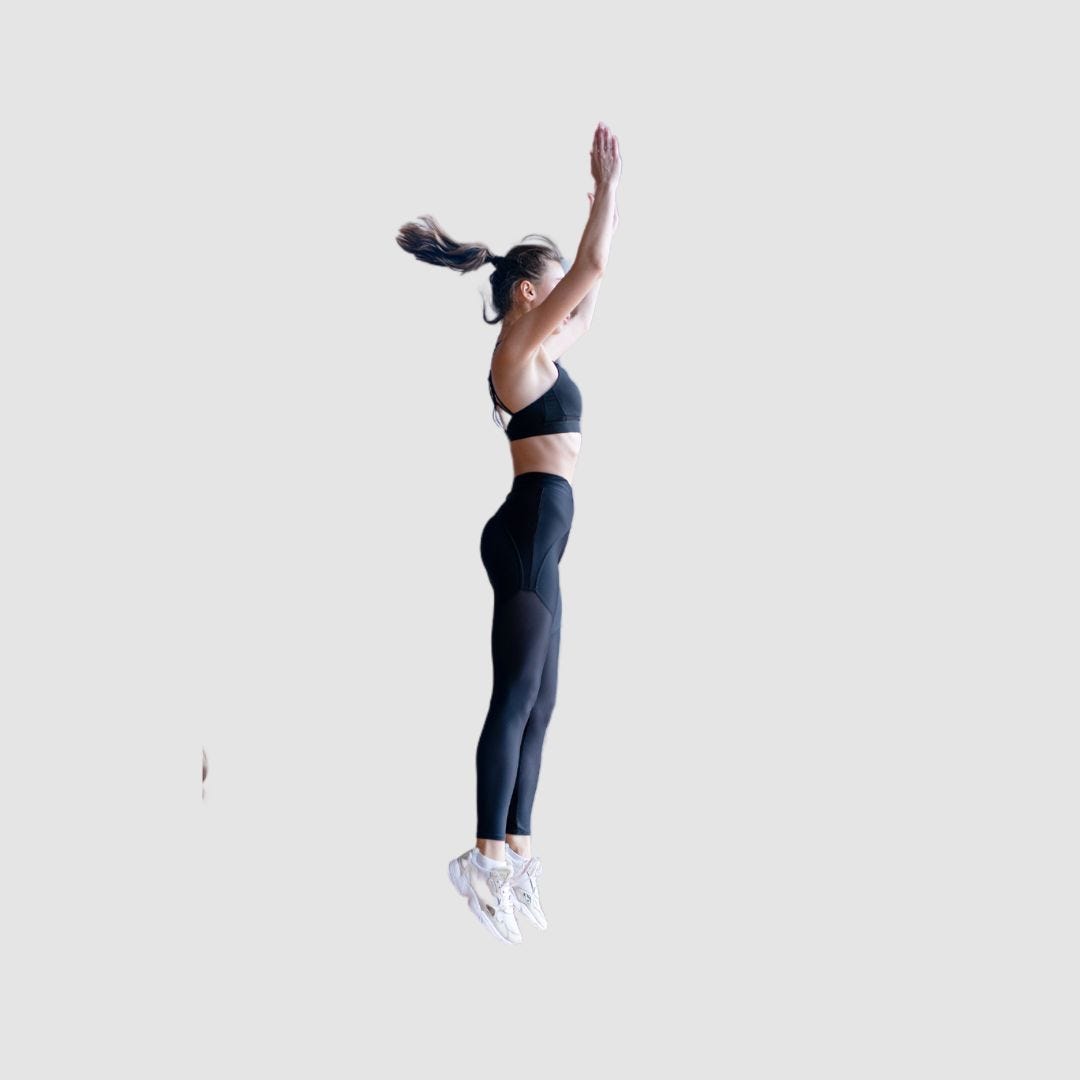
Low countermovement (vertical) jump power can be measured using force plates (see section below). In a prospective community cohort study in 2023, Hong et al.2 showed that low jump power can be used to predict higher risk of fracture. They also demonstrated that individuals with low jump power have an increased risk of fractures, even if they do not fall under the classic definition of sarcopenia.
These findings suggest that complex motor functions, such as the ability to generate power in a jump, significantly influence fracture risk assessment independently of sarcopenic muscle loss.
Jumping does not have to be up onto a Crossfit-style 90cm high box! If you have not jumped since you were 12 - it is perfectly acceptable to jump up in the air and hold on to the back of a sturdy chair or the kitchen counter in the beginning. As you gain more confidence, progress to jumping as high as you can or onto a low step. Land with both feet as if you mean it - make some noise!
Outside getting older, risk factors for low bone mineral density include3:
low energy availability (LEA) for endurance athletes (running4, swimming, cycling5)
current or history of low body weight
low quality diet, nutritional deficiencies
lack of physical exercise
smoking
alcohol
loss of estrogen signalling
disease states: diabetes, arthritis, thyroid
family history
Jump for joy!
Force Plates, Jump Power & Athletic Performance
Jump power can be measured with a force plate - you stand on a base and jump up and it measures the ground reaction forces, typically in Newtons (N). The frequency of the force-data can be used to calculate other metrics like velocity, power and displacement. In plain language, it is a fancy bathroom scale to measure how fast you move upwards and how much strength you exert through muscle contraction onto the plate through your feet. Have a look at this video showing how it is used.


Force plates are used in elite sports 6 to monitor various aspects of training effectiveness, return to play after injury and performance readiness7. For example, if you are unrecovered one of the first metrics to decline is your ability to move fast - your velocity slows down. The rate at which you jump up will be slower with increasing neuromuscular fatigue8.
If you are unrecovered, you will move slower in movements that require explosive power like box jumps and snatches.
Basketball, netball and other ball sport athletes perform high intensity accelerations, decelerations, changes in direction and vertical jumps. A recent study by Reiter et al.9 showed that force plate metrics can be used effectively to monitor single leg lateral jump performance in NCAA Division 1 basketball players. Another study used force plate vertical jump metrics to predict return to sport performance six months after anterior cruciate ligament (ACL) reconstruction10.
Renowned world champion Powerlifter and strength and conditioning coach to aspiring Olympians, Travis Mash uses force plates and similar devices in his approach to velocity based training. It helps him determine whether the athlete needs to focus on increasing strength or train for more power to move faster.
For barbell athletes, weightlifters and Crossfitters, the speed with which you move the barbell is crucial. GymAware product RS and FLEX track load and movement speed to create a load-velocity profile. Coaches and athletes can track 1RM progress, daily readiness, fatigue and power.
Unfortunately, most of us will never use a force plate. Although the technology is available, it is still very expensive and only used in elite sports and rehabilitation. Let’s hope this will change in the future and we will all be able to track our power over time.
Our ability to maintain muscle power - or at least limit the rate of decline with age - is crucial as we age. Low muscle power is a major predictor of fall risk.
Podcast recommendation: Better Brain Fitness
#52: Can you Increase Neuroplasticity as you Age?
Dr Tommy Wood is one of my favourite researchers on all things brain related. He explores how to keep your brain healthy as you age as well as treatment and recovery from brain injury. He works with drivers in Formula 1.
Dr Tommy teams up with neurologist Josh Turknett as co-host for the Better Brain Fitness Podcast.

References:
Tucker LA, Strong JE, LeCheminant JD, Bailey BW. Effect of two jumping programs on hip bone mineral density in premenopausal women: a randomized controlled trial. Am J Health Promot. 2015 Jan-Feb;29(3):158-64. doi: 10.4278/ajhp.130430-QUAN-200. PMID: 24460005.
Hong N, Burm SW, Kim HC, Kim CO, Rhee Y. Jump Power Predicts Fracture Risk in Older Adults Independent of Sarcopenia and FRAX. J Bone Miner Res. 2023 Jul;38(7):958-967. doi: 10.1002/jbmr.4825. Epub 2023 May 30. PMID: 37191218.
Pouresmaeili F, Kamalidehghan B, Kamarehei M, Goh YM. A comprehensive overview on osteoporosis and its risk factors. Ther Clin Risk Manag. 2018 Nov 6;14:2029-2049. doi: 10.2147/TCRM.S138000. PMID: 30464484; PMCID: PMC6225907.
Do we need to change the guideline values for determining low bone mineral density in athletes? Kristin L. Jonvirk, Monica K. Torstveit, Jorunn Sundgot-Borgen, and Therese Fostervold Mathisen. Journal of Applied Physiology 2022 132:5, 1320-1322
Klomsten Andersen O, Clarsen B, Garthe I, et al Bone health in elite Norwegian endurance cyclists and runners: a cross-sectional study BMJ Open Sport & Exercise Medicine 2018;4:e000449. doi: 10.1136/bmjsem-2018-000449
Schuster J., Bove D., & Little D. Jumping Towards Best-Practice: Recommendations for Effective Use of Force Plate Testing in the NBA. Sport Performance & Science Reports. 2020; 1(97).
Philipp NM, Cabarkapa D, Nijem RM, Fry AC. Changes in countermovement jump force-time characteristic in elite male basketball players: A season-long analyses. PLoS One. 2023 Sep 27;18(9):e0286581. doi: 10.1371/journal.pone.0286581. PMID: 37756277; PMCID: PMC10529540.
Heishman A., Miller R. M., Freitas E. D. S., Brown B. S., Daub B. D., & Bemben M. G.Monitoring external training loads and neuromuscular performance for division I basketball players over the Pre-Season. Medicine & Science in Sports & Exercise. 2019; 51(6S), 35–35. doi: 10.1249/01.mss.0000560595.64671.b6
Reiter CR, Killelea C, Faherty MS, Zerega RJ, Westwood C, Sell TC. Force-plate derived predictors of lateral jump performance in NCAA Division-I men's basketball players. PLoS One. 2023 Apr 21;18(4):e0284883. doi: 10.1371/journal.pone.0284883. PMID: 37083701; PMCID: PMC10121059.
Shankar DS, Milton HA, Mojica ES, Buzin S, Strauss EJ, Campbell KA, Alaia MJ, Gonzalez-Lomas G, Jazrawi LM. Force plate jump testing metrics are predictive of performance on a multimodal return to sport testing protocol among anterior cruciate ligament reconstruction patients at minimum six-month follow-up. J Sports Med Phys Fitness. 2023 Nov;63(11):1208-1217. doi: 10.23736/S0022-4707.23.14850-X. Epub 2023 Aug 1. PMID: 37526491.